Jackass Forever. A dirty, cringey, gut-bustingly funny cinematic soul-cleanse. Bound for my end-of-year top 10 just like the other Jackass movies.
Everything Everywhere All At Once. I think I need to see this at least twice to fully appreciate it, not for any plot reasons but because it really lives up to its title.
Winning Time. I enjoyed this HBO Max show enough to keep watching, but not enough to stick with it after the first season ends next week.
A World Lit Only By Fire: The Medieval Mind and the Renaissance by William Manchester. Just started reading this and know already it will be a feast. More to come.
Apollo 10 1/2: A Space Age Childhood. Richard Linklater’s latest film synthesizes elements from two of his previous ones: the quotidian nostalgia of Boyhood and the rotoscope animation style of A Waking Life.
Summer of Soul. The two words that came to me after watching this concert documentary: exuberance and excellence.
Index, A History of the: A Bookish Adventure from Medieval Manuscripts to the Digital Age by Dennis Duncan. Three stars for the book itself, five stars for the title.
Extra Life: A Short History of Living Longer by Steven Johnson. My favorite author does it again, using his signature storytelling savvy to explain how human life expectancy has doubled in the last century. Vaccines, epidemiology, pasteurization, drug regulation, penicillin, and automobile safety sound like dry topics, but how they came to be is anything but.
KIMI. A lean techno-thriller from Steven Soderbergh.It’s like Searching meets Rear Window with a dollop of COVID paranoia.
Station Eleven. The book was on my list of favorite books of the 2010s, so I was cautiously optimistic about this limited series adaptation. Glad to find it totally lived up to the spirit of the book while thriving as its own thing. Special shout-out to episodes 1 and 9 for being exceptional television.
Hud. That Paul Newman was a gosh-darn movie star.
We Had A Little Real Estate Problem: The Unheralded Story of Native Americans & Comedyby Kliph Nesteroff. Told in rotating vignettes, this book spotlights Native American performers and comedians who have used comedy to cope and reckon with the shameful abuse of Native Americans throughout history.
The Tender Bar. A likable coming-of-age story, with Ben Affleck as the wise and weathered uncle.
The Last Duel. A stellar cast and interesting premise, telling the story and fallout of a rape in medieval France from multiple perspectives. It’s good but also a tough sit.
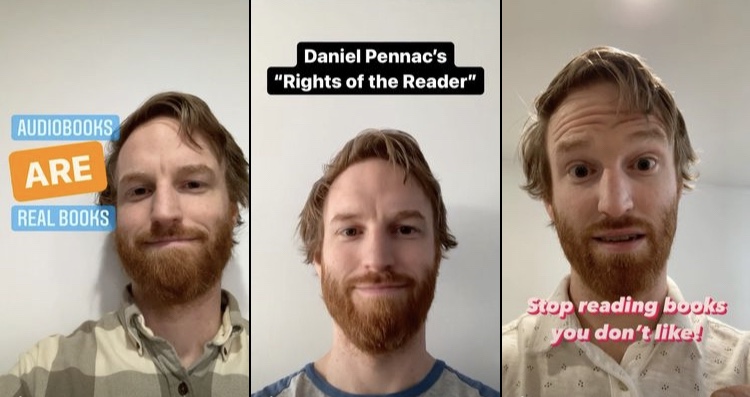
I don’t use TikTok but I’ve started making Instagram Reels for work and have grown to appreciate the format, however much of a time-suck it can be. There’s lots of creative, funny, and relatable ones out there if you can navigate the ever-changing algorithm.
I figured the easiest way in for me personally was to dash off a few of my strongly held (and correct) assertions about reading and books:
Based on the responses I’ve gotten, if only from friends, they have clearly touched a nerve. There are lots of shame-based reading practices lurking out there, and I’ve now made it my mission to target and destroy them.
I will probably branch off from bookish takes at some point. (Lord knows I have thoughts on movies, libraries, and typewriters at least.) But like my M.O. with this blog, I’ll wait for inspiration to strike.
With that in mind, here are the books from 2021 that stuck with me.
10. The Great Glorious Goddamn of It All by Josh Ritter
Josh Ritter, creator of one of my favorite albums of all time, dropped his second novel this year and it was quite good. I read the audiobook, which was narrated by Ritter (and probably shouldn’t have been [professional musicians ≠ professional narrators]). But I still enjoyed the narrative voice of the main character, reminiscing about his time in the lumberjack era of early 20th century Idaho.
Choice quote:
Memory comes in to fill the spaces of whatever isn’t there. … Memory has a way of growing things, of improving them. The hardships get harder, the good times get better, and the whole damn arc of a life takes on a mystic glow that only memory can give it.
9. Wonderworks: The 25 Most Powerful Inventions in the History of Literature by Angus Fletcher
I can certainly understand the criticisms of this book, which examines literature through a utilitarian/scientific lens that can come across as reductive. But since books are technology (which Fletcher defines as “any human-made thing that helps to solve a problem”), then it’s perfectly legitimate and even necessary to explore them as such. Examples include the catharsis of Greek tragedies helping to purge fear (while mimicking the benefits of modern EMDR therapy) and riddles activating information-seeking neurons that trigger dopamine hits. The author’s appearance on Brené Brown’s podcast is a good introduction to what you can expect.
Choice quote:
Literature was a narrative-emotional technology that helped our ancestors cope with the psychological challenges posed by human biology. It was an invention for overcoming the doubt and the pain of just being us.
8. The Plot by Jean Hanff Korelitz
This was a late-year read after Malcolm Gladwell raved about it in his newsletter. Figured it was worth a try as I rarely read mysteries or thrillers. Indeed it was fun to go on the ride of a novelist who comes upon another writer’s plot, harnesses it into mega-fame, then deals with the fallout. As with movies, I didn’t try to figure out the ending as I went, so when the twist arrived it felt earned and as if it were there the whole time.
Choice quote:
Once you were in possession of an actual idea, you owed it a debt for having chosen you, and not some other writer, and you paid that debt by getting down to work, not just as a journeyman fabricator of sentences but as an unshrinking artist ready to make painful, time-consuming, even self-flagellating mistakes.
7. The Anthropocene Reviewed by John Green
This collection of essays originated as a popular podcast by the author, which “reviews facets of the human-centered planet on a five-star scale.” Topics include “humanity’s temporal range”, Canada geese, Indianapolis, and many other things you didn’t realize could make for viable essays. Green’s earnest, wending style and keen observational approach makes for very pleasant reading.
Choice quote:
All I can say is that sometimes when the world is between day and night, I’m stopped cold by its splendor, and I feel my absurd smallness. You’d think that would be sad, but it isn’t. It only makes me grateful.
6. Bewilderment by Richard Powers
After I gave up on Powers’ massive The Overstory, I was glad for a shorter story to glom onto. This one, set in my hometown of Madison, follows a recently widowed astrobiologist professor struggling to raise his perspicacious but troubled nine-year-old amidst increasing political, professional, and climatological turmoil. How do you look for life in the stars when it’s under threat on earth?
Choice quote:
Life is something we need to stop correcting. My boy was a pocket universe I could never hope to fathom. Every one of us is an experiment, and we don’t even know what the experiment is testing.
5. In the Heights: Finding Home by Lin-Manuel Miranda
For me 2021 was already the Year of Lin-Manuel Miranda due to his music in In the Heights, Vivo, and Encanto, and direction of tick, tick… BOOM! And yet I still managed to sneak in this book documenting the journey of Miranda’s first musical to the stage and screen (now in my top 10 of 2021), complete with Miranda’s characteristically vivacious libretto annotations.
Choice quote:
The rush of the final Usnavi section stays with me always, and my prevailing memory of performing it is the faces in the front row of the Rodgers Theatre: our $20 section, often filled with young people seeing their first musical on Broadway. I lock eyes with them, night after night, and as their eyes fill with tears, so do mine. I’m delivering these words, but I’m also trying to tell them: I’m home, and Usnavi’s home, and in this time you’ve chosen to spend with us, so are you. Welcome home.
4. Miracle and Wonder: Conversations with Paul Simon by Malcolm Gladwell
Available only as an audiobook, this “audio biography” centers around hours of conversations between Simon and Gladwell about the genius musician’s life and career. It’s less a book and more a limited podcast series, which now seems like the only right way to do a music biography. Made me appreciate Simon’s work anew. (Review)
Choice quote:
Taste is the combination of memory and judgment.
3. Paper Trails: The US Post and the Making of the American West by Cameron Blevins
Learned a lot from this history, which is primarily for 19th century American history nerds but is still refreshingly accessible and peppered with illustrative graphs throughout. (Review)
Choice quote:
Despite the popular ‘Wild West’ narrative of self-reliant cowboys and pioneers, the real history of the region is one of big government: public land and national parks, farming subsidies and grazing permits, military bases and defense contracts. Arguably no other part of the United States has been so profoundly shaped by ‘the state’.
2. Four Thousand Weeks: Time Management for Mortals by Oliver Burkeman
An approachably philosophical exploration of the wily, incorrigible thing called time and humanity’s dysfunctional relationship with it. It’s like a self-help book that deconstructs the need for self-help books. (Review)
Choice quote:
If you can hold your attention, however briefly or occasionally, on the sheer astonishingness of being, and on what a small amount of that being you get—you may experience a palpable shift in how it feels to be here, right now, alive in the flow of time.
1. The Memoirs of Stockholm Sven by Nathaniel Ian Miller
I’d never have heard of this one, let alone picked it up and read it, if it weren’t for a tip from my mother-in-law. This fictional cradle-to-grave memoir follows the misadventures of a caustic early-20th-century Swedish man who, disfigured in a mining accident, retreats to an Arctic archipelago for a self-imposed exile, only to almost accidentally collect a motley crew of friends (human and canine) and reconnect with family in surprising ways. Miller’s exceptionally crafted narrative voice and eye for harsh natural beauty made this a rewarding read.
Choice quote:
For now, take stock of yourself. This is the chance you waxed about so long ago. Listen for the voice that speaks when all others go silent. Be alone—be entirely alone. I am not saying you will find anything of worth there—certainly no cosmic truth—but maybe you will begin to feel as pared down, efficient and clean as a freshly whittled stick.
While trolling for something to read on Hoopla, I came upon Malcolm Gladwell’s new book Miracle and Wonder: Conversations with Paul Simon. It’s only available as an audiobook (or “audio biography”), and wisely so since so much of it depends on hearing Simon play his songs amidst his conversations with Gladwell. In that way it’s more like a limited podcast series than a book.
Whatever you call it, Gladwell’s intention was to interrogate the phenomenon of creative genius, and pinpoint how and why it applied to Simon, whose long and wide-ranging musical career set him in contrast to other contemporary artists who may have had higher peaks (The Rolling Stones, Bob Dylan) but didn’t produce at the same level of quality over decades as Simon has.
We tend to be much more caught in the peaks of an artist’s career. But why? The true definition of creative genius—to my mind, at least—is someone who is capable of creating something sublime and then, when that moment passes, capable of reconfiguring their imagination and returning to the table with something wholly different and equally sublime.
Whether Simon meets this criteria is debatable, though Gladwell makes a good case for it.
The other Paul
Regardless, the book found me at a propitious time since I just finished watching and listening to the other famous ’60s singer-songwriter Paul in the documentary The Beatles: Get Back. The film captures McCartney in his first sublime period, which coincided with the transition between The Beatles and his solo work.
His career as a whole is eerily similar to Simon’s: incredible creative and commercial success within a popular group throughout the 1960s, followed by an acrimonious breakup in 1970 and then decades of steady solo output of variable quality.
Per Gladwell’s formulation, both men created something sublime within a relatively condensed cultural moment, then reconfigured their output after that moment passed. Whether those later albums were “wholly different and equally sublime” depends on where you look.
If it’s a choice between The Beatles and Simon & Garfunkel, I choose the Fab Four all the way. (My cheeky Better The Beatles series notwithstanding.)
But solo-wise, I think Simon’s exceptional ‘70s work combined with the highlights of Graceland (1986), The Rhythm of the Saints (1992), and So Beautiful or So What (2011) give him the edge over McCartney, whose early solo work was definitely the best of all the ex-Beatles (though not perfect), but didn’t approach the sublime until Chaos and Creation in the Backyard (2005) and Memory Almost Full (2007).
Seeing Paul McCartney at Wrigley Field just over 10 years ago remains an all-time life highlight. (By seeing I mean standing outside Wrigley listening and singing along and barely catching a glimpse of him on the Jumbotron. But still.) I regret not being able to see Paul Simon live, as I imagine it would have been just as good but delightfully different. Which, perhaps, is what Gladwell would consider it too.
From the remarkable book How the Irish Saved Civilization by Thomas Cahill:
“Like the Jews before them, the Irish enshrined literacy as their central religious act. In a land where literacy had previously been unknown, in a world where the old literate civilizations were sinking fast beneath successive waves of barbarism, the white Gospel page, shining in all the little oratories of Ireland, acted as a pledge: the lonely darkness had been turned into light, and the lonely virtue of courage, sustained through all the centuries, had been transformed into hope.”
Love on the Spectrum. Just finished the second season of this heart-warming and instructive Australian reality dating show on Netflix featuring people on the autism spectrum. The delightful dynamic between Michael and his mom should be its own show.
Abbey Road. I previously wrote about encountering the super deluxe remastered edition of Sgt. Pepper’s and, by Jove, it happened again with my favorite Beatles record on a recent drive home. Luscious.
The Song of Achilles by Madeline Miller. Finally read Miller’s debut novel after loving Circe, and she is now two for two in my book.
The Great British Baking Show. The current season is only the second we’ve seen, the first being last year’s COVID-bubble season. Mr. Almost-3 has started saying “Mmmmm, yummmm” every time the food drawings appear, which is (almost) always correct.
The Green Knight. Thought this was just OK for a large chunk of it, until the ending, which made me want to rewatch it immediately.
Witness for the Prosecution. Similar to The Green Knight, this was fine for a while until the end, when it became great. The acting was a bit over-the-top, even for the 1950s, but Charles Laughton was the tops throughout.
Shiva Baby. Nothing quite like seeing a writer-director absolutely nail the cringey-funny tone required to make this work.
Dune. Started watching as a Dune newbie and finished as a believer. Don’t think I’ll read the books though.
Library books galore. Between my work library and the two public libraries close to home, we’ve established a pretty regular rotation of titles old and new. Recent hits include The Book With No Pictures by B.J. Novak and Bone by Bone: Comparing Animal Skeletons by Sara Levine.
Bluey. The first-ever clip I saw of Bluey was the claw game and it made me literally LOL. The best kids TV show, period.
“Dem Bones”. He really got into spooky season this year. He’s especially obsessed with all things bones and skeletons, so this old traditional was and remains a hit.
Pixar movies. Approaching 3 years old, he’s enjoyed and (mostly) stuck with the Disney/Pixar movies we’ve tried with him so far. My guess at his ranking (starting with the most loved): WALL-E, Moana, Luca, Monsters Inc., Ratatouille, Coco. Still not sure how far back in the Disney canon I want to bring him even as he gets older. There’s a lot of good stuff—though I would say that as a Millennial, wouldn’t I?—but in general Pixar is higher quality and a lot less dicey.
The Okee Dokee Brothers. Specifically “Haul Away Joe” and “Jamboree” and a few other songs on seemingly infinite rotation. Good thing I love them too.
Ever since reading Doris Kearns Goodwin’s excellent Abraham Lincoln biography Team of Rivals years ago, I’ve been fascinated by the lives and times of U.S. presidents. So much so that I made a goal to read a substantive biography of every U.S. president.
This goal isn’t motivated by politics. If anything the legislative minutiae, policy discussions, and battlefield play-by-plays are usually the dullest parts of these books. I’m simply fascinated by the peculiar power of the presidency and the stories of the men who have wielded it—even if (and when) they don’t live up to our twenty-first century expectations.
Any biography I read will teach me something, regardless of the likeability of the subject or overall quality of the book. But the best of them combine compelling prose, insightful commentary, and strong storytelling that fairly recount the person’s life while contextualizing and sometimes criticizing their decisions or behavior.
With 19 down out of 45 currently, I’m nearing halfway through this literary mission, so I thought it would be a good time to check in with what I’ve read so far.
I’ve mostly stayed away from more recent presidents, preferring books that have at least a little historical distance from their subjects. (Outside of George Bush Sr., the most recent president I’ve tackled is Harry Truman.) I also endeavor to only read meaty, single-volume biographies that make this expedition feel substantive and worthwhile (if slightly masochistic).
All that said, here are a few titles that have stood out thus far, in no particular order.
For a long time the only things I knew about Hayes were that his heavily disputed 1876 election ended the Reconstruction era in the former Confederacy, and that he was one of those forgotten presidents between Lincoln and Roosevelt with cool facial hair. But I soon learned that Hayes was a lawyer who became an abolitionist and defended escaped slaves, a brigadier general in the Civil War who was shot in the arm in the Battle of South Mountain yet still led his men to victory, and a post-presidency education reform advocate who helped found Ohio State University. Not bad for a forgotten one-term president.
The Rise of Theodore Roosevelt by Edmund Morris
This is the first (and Pulitzer Prize-winning) book in a trilogy about Teddy Roosevelt, who might be the most impressive president we’ve ever had. It chronicles the crowded years of his pre-presidency life, which began as a sickly yet bright child who by 25 became a best-selling author and bull-headed New York legislator, then continued as a young widower who served as a Dakota sheriff, New York City police commissioner, Navy secretary, Army colonel, and New York governor, all before becoming president at 42. Energetic, fun-loving, and extremely intelligent, Roosevelt is a biographer’s dream and one of my history crushes.
John Quincy Adams: A Public Life, A Private Lifeby Paul Nagel
From birth, John Quincy Adams lived within a shadow. His father, John, the legendary Founding Father and fiery orator, pushed John Quincy hard in his studies and inspired him to greatness. But the greatness JQA achieved—e.g. speaking multiple languages, serving as George Washington’s minister to the Netherlands at age 26—always seemed to forestall his desire to live a quiet, scholarly life away from politics and his father’s prodding. Historian Paul Nagel captures all of this in addition to Adams’ unimpressive term as president and surprising final act as an ardent abolitionist congressman. (Another bit of trivia: He was probably the only person to have known both George Washington and Abraham Lincoln personally.)
The Presidents Club: Inside the World’s Most Exclusive Fraternity by Nancy Gibbs and Michael Duffy
The standard photo-op of a new president standing cordially with all of his living predecessors is common, but that wasn’t always so. Herbert Hoover and Harry Truman created the so-called “former presidents club” in the 1950s, and since then the relationships formed behind the scenes between members have often been surprising (like with rivals-turned-best-friends George Bush Sr. and Bill Clinton) and sometimes subversive (like when Richard Nixon deliberately sabotaged Lyndon Johnson’s peace talks in Vietnam to aid his own 1968 campaign). The book is a fascinating account of how the private and public lives in “the world’s most exclusive fraternity” have interweaved throughout modern political history.
Other favorites:
Team of Rivals: The Political Genius of Abraham Lincoln by Doris Kearns Goodwin (the for-me OG!)
John Adams by David McCullough (sets the standard for POTUS biography greatness)
Matt Haig’s novel The Midnight Library asks: What if you could explore every what-if of your life, specifically those that turned into regrets? How many of your other lives would actually turn out better than your real one?
It’s an intriguing philosophical question that quickly turns personal for the book’s protagonist, Nora Seed, who comes to learn that each book in the titular library—rendered as a kind of metaphysical manifestation of purgatory—represents one of the infinite versions of her life.
Adventures in space-time
The idea of exploring what-ifs through magical realism or sci-fi isn’t new. It’s the narrative foundation of some of my favorite films (It’s A Wonderful Life, Back to the Future trilogy) and other intriguing cinematic counterfactuals (The Man in the High Castle, The Last Temptation of Christ, About Time).
But rather than focusing on (as Doc Brown would call it) one specific temporal junction point in the entire space-time continuum—what if George Bailey had never lived, what if Biff stole the Almanac, what if the Nazis won—The Midnight Library extends its ambit to the many sliding-doors moments in a single life.
Nora is given countless opportunities to choose and experience parallel lives where none of her regrets came to pass. “I stayed with that ex-boyfriend” and “I didn’t give up swimming” and “I pursued my dream of becoming a glaciologist” all get a spin. But none of these supposedly ideal realities live up to her expectations.
While she’s able to shorten her list of regrets—an immensely valuable gift in itself—her pursuit of happiness doesn’t solve the deeper existential crisis that plagues all of us at some point: per Mary Oliver, what will you do with your one wild and precious life?
4,000 Weeks
That question infuses another of my recent reads: Four Thousand Weeks: Time Management for Mortals by Oliver Burkeman, an approachably philosophical exploration of the wily, incorrigible thing called time and our dysfunctional relationship with it.
I have an extensive list of quotes from the book that make for good ponderin’, but there are three specific ones that would fit right into The Midnight Library. (Synchroncity knows no bounds, temporal or otherwise.)
First, a reality check:
The world has an effectively infinite number of experiences to offer, so getting a handful of them under your belt brings you no closer to a sense of having feasted on life’s possibilities.
Therefore, Burkeman writes, you have to make choices:
Once you truly understand that you’re guaranteed to miss out on almost every experience the world has to offer, the fact that there are so many you still haven’t experienced stops feeling like a problem. Instead, you get to focus on fully enjoying the tiny slice of experiences you actually do have time for—and the freer you are to choose, in each moment, what counts the most.
And once you do that:
If you can hold your attention, however briefly or occasionally, on the sheer astonishingness of being, and on what a small amount of that being you get—you may experience a palpable shift in how it feels to be here, right now, alive in the flow of time.
That “astonishingness” of being alive in the flow of time doesn’t arrive on command. You have to reorient your mind and your attention to create the conditions that allow for it to reveal itself.
In The Midnight Library, that process looks like an anguished young woman replacing her perceived unworthiness with gratitude for mere existence. (Just like George Bailey.)
In Four Thousand Weeks, that looks like embracing temporal limitations rather than resenting them.
And in my life, that looks like treating the things I love—my wife and son and family and friends and typewriter collection and bike rides and movie nights and library books—as the temporary gifts they are, for however long I live.
I’ve been on a fiction reading tear recently. In the last fortnight I’ve finished The Great Believers by Rebecca Makkai, The Great Glorious Goddamn of It All by Josh Ritter, and The Midnight Library by Matt Haig—all with a mix of print and audiobook. I just started The Song of Achilles by Madeline Miller on audiobook and am hopeful about it.
In the midst of this streak I texted my buddies that I was resolving to read more fiction.
“It’s an ongoing struggle,” I wrote, “to come to terms with the fact that I won’t be able to learn everything I want to learn via nonfiction books, so I might as well start to nourish other parts of my consciousness too.”
My friend Steve replied: “I feel like I learn a lot about the world from nonfiction, and I learn a lot about myself (and my relationship to others) from fiction.”
Couldn’t be truer. And when I said I typically tilt much farther toward the world, he replied: “While vast, it is sometimes less daunting.” Compared, that is, to ourselves.
Wendell Berry:
Fantasy is of the solitary self, and it cannot lead us away from ourselves. It is by imagination that we cross over the difference between ourselves and other beings and thus learn compassion, forbearance, mercy, forgiveness, sympathy, and love—the virtues without which neither we nor the world can live.
Angus Fletcher:
Whatever the power of truth may be, literature’s own special power has always lain in fiction, that wonder we construct.
Schmigadoon. Though its story is a little loose at the edges throughout the show’s short six-episode run, the central conceit of a couple getting stuck inside the world of an old-timey musical was a fun journey. Watch out for “Corn Puddin’” because it’s an earworm. More TV musicals please!
Ted Lasso, season 2. Will be curious to see how this season fills out as a whole, but nothing can damper my love of the best show on TV. We really enjoyed the stretch of a couple weeks in July and August when we could watch the latest episodes of this and Schmigadoon as an uplifting and wholesome Friday night double feature.
Crimson Tide. So, this ruled. And made me really miss seeing Gene Hackman in movies.
In the Heights(movie and soundtrack). Seeing this was my first time back in the theater since February 2020, and I’ve had the soundtrack pretty much on repeat since. Favorite little moments: “damn, we only jokin’, stay broke then” and the It’s A Wonderful Life reference.
Ghost Map: The Story of London’s Most Terrifying Epidemic by Steven Johnson. My favorite author strikes again.
A Quiet Place / A Quiet Place Part II. Being horror-averse I put off the first one for a while, basically until I saw the excellent reviews for Part II and realized they’re not actually horror but more of the “momentarily scary well-made thriller” variety, which I’m down with.
Paper Trails: The US Post and the Making of the American West by Cameron Blevins. Shoutout to the post office.
Showbiz Kids. Affecting documentary on HBO Max featuring former child actors talking about their past and present struggles.
The Anthropocene Reviewed by John Green. I’ve never listened to the podcast this book is based on, but still enjoyed Green’s unique, earnest, and wry literary voice shining through this collection of essays.
One thing that popped out to me was the role of women in the Post Office’s workforce. Women made up two-thirds of all Post Office employees by the end of the 1870s, with the Post Office itself accounting for 75% of all federal civilian employees at the time. This made it a vital source of work for women early in the movement for women’s suffrage.
Their chief work was within the Topographer’s Office, which produced maps of postal routes. The layout and drawing of the maps was done by men (it was actually called “gentlemen’s work”). But the “ladies’ work” of coloring the routes according to frequency of delivery was arguably just as if not more important, because it added the dimension of time to the otherwise inert graphics and kept the maps up to date and therefore useful.
This wasn’t easy given the constantly changing routes and limitations of paper. As Blevins put it: “These women were, in effect, trying to paint a still life while someone kept rearranging the fruit.”
All this was on my mind when I saw Richard Polt’s Instagram post for International Typewriter Day.
I’m not sure how much typewriters factored into the work of the female “colorists” given its graphical nature, but the people’s machine without a doubt contributed to the societal sea change happening concurrently as women marched first into offices and then, eventually, the voting booth.
Anyway, I recommend Paper Trails primarily for history nerds—specifically 19th century America. The academic writing is refreshingly accessible and peppered with illustrative graphs throughout. I’m happy to file it under my “technically first” series of books about how innovative technologies came into being.
When I learned Steven Johnson (my favorite author) has a new book out, it prompted me to finally read one of his previous books that’s been on my list for a while.
The Ghost Map: The Story of London’s Most Terrifying Epidemic—and How It Changed Science, Cities, and the Modern World was a timely read, for obvious reasons. Though cholera is a different beast than COVID (“Imagine if every time you experienced a slight upset stomach you knew that there was an entirely reasonable chance you’d be dead in forty-eight hours”), its effect in this story and throughout history shows us both how far science has come since the Victorian Age and how vulnerable we remain to infectious diseases.
What I love most about this book—even beyond the historical factoids and masterful storytelling you can expect from any Johnson joint—is that it’s basically a murder mystery, with cholera as the microbial serial killer and an unlikely detective duo of a doctor and a priest hunting it during a deadly epidemic in the crowded, putrid London of the 1850s.
Call it an epidemiological thriller. Probably not much competition in that sub-genre, but Johnson made the most of it.
Quotes
I like Johnson’s description of London at the time:
an industrial-era city with an Elizabethan-era waste-removal system as perceived by a Pleistocene-era brain.
On the topography of progress:
The river of intellectual progress is not defined purely by the steady flow of good ideas begetting better ones; it follows the topography that has been carved out for it by external factors.
On great intellectual breakthroughs:
It is rarely the isolated genius having a eureka moment alone in the lab. Nor is it merely a question of building on precedent, of standing on the shoulders of giants, in Newton’s famous phrase. Great breakthroughs are closer to what happens in a flood plain: a dozen separate tributaries converge, and the rising waters lift the genius high enough that he or she can see around the conceptual obstructions of the age.
It’s not just that the authorities of the day were wrong about miasma; it’s the tenacious, unquestioning way they went about being wrong. …
How could so many intelligent people be so grievously wrong for such an extended period of time? How could they ignore so much overwhelming evidence that contradicted their most basic theories? These questions, too, deserve their own discipline—the sociology of error.
The Good Lord Bird. The limited series really captures the book’s madcap and dramatic spirit. Ethan Hawke is so delightfully committed to the dead-serious absurdity of John Brown.
The Underground Railroad. Two of my main takeaways while watching this 10-episode limited series: 1. I can’t believe I get to watch essentially 10 new Barry Jenkins movies! And 2. That’s a few too many given the heavy subject matter!
Art Blakey & The Jazz Messengers, A Night in Tunisia. Recently my wife asked me to “get some jazz” from the library, so right before I left I grabbed a few albums more or less at random. Struck gold with this one.
Benny Goodman, Mozart at Tanglewood. Wanted to find some good concertos and heard good things about this one. Those good things were right.
Fake Love Letters, Forged Telegrams, and Prison Escape Maps: Designing Graphic Props for Filmmakingby Annie Atkins. A cool visual compendium and behind-the-scenes exploration of a film graphic prop designer’s impressive work, including lots from Wes Anderson movies.
Based on the ongoing series, here are the books, movies, and music my two year old is into recently.
So. Many. Books. We have shelves stuffed with board and picture books in four different rooms of our house, plus a stash of library books, so he’s never lacking literature. Some current favorites: Sandra Boynton’s Pookie series, Tap Tap Bang Bang, There’s a Mouse About the House!, and really anything related to trucks.
So. Much. Music. He’s a big fan of the Super Simple Songs catalog, which introduces him to childhood staples like “BINGO” and “Old McDonald”. But it’s very important to me that he gets exposed to quality music for adults too. The last few weeks we’ve listened and/or danced to pop and rock (The Beatles, Paul Simon, HAIM), soul (Aretha Franklin, Sam Cooke, Ben E. King), classical (Mozart, Haydn, Handel), country/folk (Willie Nelson, Uncle Earl, Joe Pug), hip hop (Jay Z, The Roots), and jazz (Stan Getz, Oscar Peterson). Cue The Onion.
Peppa Pig. Might be my favorite of his things to watch. It’s the go-to for when we (or he) need a break. The delightful British silliness has made me laugh a few times.
Daniel Tiger’s Neighborhood. Like its ancestor Mister Rogers’ Neighborhood, it’s a sincere (often saccharine), educational, and wholesome vessel for social-emotional development. Bonus points for all the jingles that are helpful for kids and parents (e.g. “When you feel so mad that you want to roar, take a deep breath and count to four.”).
Caitie’s Classroom. Part of the aforementioned Super Simple universe, this YouTube show is also very Mister Rogers-esque, with the cheerful Caitie leading crafts, songs, and field trips that he’s learned a lot from already.
An ongoing series of books, movies, and music I’ve encountered recently.
(Haven’t done this since before the end-of-year list-o-mania, so check out my favorite books and films of 2020 for a fuller “Media of the Moment” experience.)
Ted Lasso. Throughout the whole 10-episode first season I kept thinking, “How is this show real?” Can’t wait for season two.
Down from Basswood by Lynn Maria Laitala. Went long on this short, wondrous book.
Palm Springs. I love when comedic actors, like Andy Samberg in this instance, stretch into drama. Also love when a movie manages to mix so many genres well—in this case comedy, romance, sci-fi, drama, and even philosophy.
Run. The latest thriller from Aneesh Chaganty (whose debut film Searching was one of my favorites of 2017) puts Sarah Paulson right where she shines, in a role that cloaks a dark edge with a sunny surface. Kudos to her co-star Kiera Allen for an impressive debut.
The Splendid and the Vile: A Saga of Churchill, Family, and Defiance During the Blitz by Erik Larson. Listened to the audiobook and enjoyed when the British narrator adopted Winston Churchill’s distinctive even-more-British accent when quoting him. Remember to be brief.
The Dig. Like The Splendid and the Vile, a stately story set in World War II Britain that was just OK—though Carey Mulligan and Ralph Fiennes were, as always, the best part of it).
Jimmy Carter: Rock & Roll President. Documentary about the influence of music and musicians on Carter and his 1976 presidential campaign. Had no idea he was best friends with Bob Dylan and Willie Nelson. Perhaps I’ll make him my next presidential biography…
Contagion. Finally dove into this Steven Soderbergh joint that was eerily prescient about pandemic life, though thankfully more extreme than what COVID-19 hath wrought.
Wings. This 1927 silent film was the first winner of the Academy Award for Best Picture (technically “Outstanding Picture”). About 30 minutes too long but strikingly style-forward for its time, as this stunning tracking shot demonstrates.
Ghosts of the Abyss. Went on a Titanic kick a while back and stumbled upon this documentary from James Cameron on his 2001 expedition to the Titanic wreck, which captured some incredible footage.
Only Lovers Left Alive. Between this, Broken Flowers, and Patterson, I have yet to be let down by Jim Jarmusch.