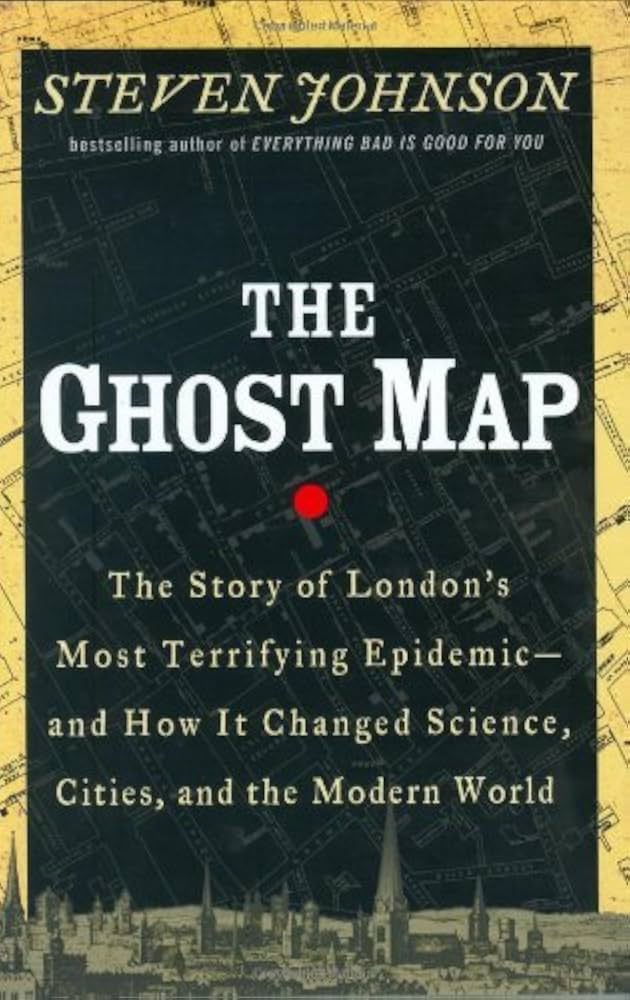
Book is “the story of a map created to help make sense of an experience that defied human understanding”
Water-flushing device invented in sixteenth century by Sir John Harington for Queen Elizabeth, but didn’t take off until late 18th and early 19th century
“The history of knowledge conventionally focuses on break through ideas and conceptual leaps. But the blind spots on the map, the dark continents of error and prejudice, carry their own mystery as well.”
“How could so many intelligent people be so grievously wrong for such an extended period of time? How could they ignore so much overwhelming evidence that contradicted their most basic theories? These questions, too, deserve their own discipline—the sociology of error.”
“Epidemics create a kind of history from below: they can be world-changing, cut the participants are almost inevitably ordinary folk, following their established routines, not thinking for a second about how their actions will be recorded for posterity.”
“Imagine if every time you experienced a slight upset stomach you knew that there was an entirely reasonable chance you’d be dead in forty-eight hours.”
Cholera bacteria need to be ingested in order to colonize small intestine and trick it into expelling water rather than absorbing it; dehydration reduces blood volume, which triggers organ shutdown (though brain remains aware)
Victims can lose more than 10% of body weight within 24 hours
New bacteria in copious water BMs and sweat allow for quick transmission; cholera needs excrement eating to thrive, so for most of history didn’t travel well beyond “brackish waters of the Ganges delta” until densely populated urban areas with contaminated drinking water became commonplace
Water injection was effective cure but drowned out by quack remedies amplified by newspaper advertising
London doctor John Snow saw first public demonstration of ether for anesthetic in 1846; soon deduced importance of room temp for efficacy and built delivery device
Snow administered chloroform for Queen Victoria’s eighth birth in 1853
“In a city like Victorian London, unchallenged by military threats and bursting with new forms of capital and energy, microbes were the primary forced reigning in the city’s otherwise runaway growth, precisely because London had offered cholera (not to mention countless other species of bacterium) precisely what it had offered stockbrokers and coffeehouse proprietors and sewer-hunters: a whole new way of making a living.”
Confluence of urban living and discovery of alcohol created massive selection pressure on genes of humans that abandoned hunter-gatherer lifestyle for city living, where alcohol was only safe alternative to water
The Times ran series on existing theories about cholera, none of which were waterborne or microscopic
“It’s not just that the authorities of the day were wrong about miasma; it’s the tenacious, unquestioning way they went about being wrong.”
Why miasma was so persuasive: social prejudice, convention, conceptual limitations, failures of imagination – “a kind of perfect storm of error”
“Malaria” derives from Italian mal aria, “bad air”
Brain primed to use smell as alarm, and smell is a lot easier to detect than microbes
Modern city was “an industrial-era city with an Elizabethan-era waste-removal system as perceived by a Pleistocene-era brain”
“The river of intellectual progress is not defined purely by the steady flow of good ideas begetting better ones; it follows the topography that has been carved out for it by external factors.”
Snow unique resistant to miasma assumptions given his work with ether/chloroform, which responded predictably across patients unlike miasma vapors
Snow observed cholera’s effect on gut, but nothing on respiration
Snow’s nearness to outbreak and upbringing with working poor gave him unique insight into investigation, and no bias towards “moral failing” view of afflicted poor
“Snow’s theory was like a ladder; each individual rung was impressive enough, but the power of it lay in ascending from bottom to top, from the membrane of the small intestine all the way up to the city itself.”
On great intellectual breakthroughs: “It is rarely the isolated genius having a eureka moment alone in the lab. Nor is it merely a question of building on precedent, of standing on the shoulders of giants, in Newton’s famous phrase. Great breakthroughs are closer to what happens in a flood plain: a dozen separate tributaries converge, and the rising waters lift the genius high enough that he or she can see around the conceptual obstructions of the age.”
Florence Nightingale of the nurses at the local hospital dealing with the influx of cholera patients
Snow argued to local Board of Governors to shut down the Broad Street pump and its handle was removed on Friday, exactly a week after rampage started; met with derision
Local reverend Henry Whitehead had been visiting victims all week and vowed to disprove waterborne theory, but gradually the data won him over
No local sewers or cesspools had access to famously pure Broad Street well water, so had to be “index case” (original cholera victim) whose evacuations made their way to the well
Whitehead looking through records at Registrar-General’s Office when stumbled upon record of baby Lewis, whose sickness, soiled diapers, and death lined up perfectly as index case (lived right by pump)
Cesspool at 40 Broad (Lewis residence) was feet away from the well and had seeped into the decaying well
Snow created map to illustrate spread based on nearness to pump (Voronoi diagram); triumph of information design but also marketing that helped waterborne theory find audience eventually
Snow and Whitehead solved local mystery that led to global solutions that “transformed metropolitan living into a sustainable practice”
“The Broad Street case was certainly a triumph of epidemiology, scientific reasoning, and information design. But it was also a triumph of urbanism.”
Germ theory ascendant by end of 19th century, as was establishing sanitary water supplies and waste removal; arguably more important than electrical grids of the same time
London’s system eliminated outbreaks, though still happened elsewhere into the 20th century
Whitehead: “In any profession the highest order of work is achieved, not by fussy empirical demands for ‘something to be done,’ but by patient study of the eternal laws.”