In an email thread about the controversies surrounding the removal of statues, I suggested we relocate all statues to museums and use the space for parks and Little Free Libraries.
But that’s destroying history! First Amendment!
Statues aren’t history, as this Twitter thread by Elle Maruska articulates well:
Statues are mythology. Statues are hagiography. If you care about history as a discipline, as a way of analyzing the past, tear down every single statue.
Somehow, the history of Nazi Germany is available without statues of Hitler in every German square.
We can somehow still access the history of Mussolini’s rule without having statues of him in Rome.
We know about Ceaușescu without his stone visage glaring out over Bucharest.
Statues tell us about how we understand the present, not the reality of the past. Statues teach us nothing but who we find worth elevating into godhood. Statues are about the lies with think are worth believing in. Statues aren’t history.
The recent spate of statue removals run the gamut from coordinated (Theodore Roosevelt’s) to chaotic (Madison’s). But all of them share the same underlying sentiment, as articulated by Kylo Ren in The Last Jedi (the only good Star Wars movie):
Let the past die. Kill it if you have to. That’s the only way to become what you were meant to be.
The irony of this sentiment is Kylo spends the entire movie trying to actually kill connections to his past but still can’t fully shake them. (After all, the past isn’t past.) As James Whitbrook writes:
So maybe “Let the past die” needs to be paired with another great quote about legacies from The Last Jedi—something Yoda says to Luke, as they watch the glowing embers of the burning tree on Ahch-To: “We are what they grow beyond.”
Just as Rey learns and grows beyond what Luke and his failures can teach her—just as she steals away those ancient Jedi texts before they can be destroyed forever, to potentially build upon their ideas herself—so must Star Wars as a franchise if it’s going to keep adding more and more stories to its ever-growing saga. Respect its past, learn from it, and let it go and move on.
As a long-running franchise and “ever-growing saga” itself, America needs to take the best of its past and let go of the rest.
Which isn’t the same as forgetting or destroying it. To me it means severing ties from two contrasting yet equally toxic and “bitter clinging” impulses: nostalgia, which insists the past was better than the present, and resentment, which only finds fault with it.
If you step back from the endless flow of social media and the internet more generally, and sit down with a book from the past that appears to have absolutely nothing to do with the affairs of the moment, something curious and rather wonderful can happen. Unexpectedly and randomly — stochastically — you begin to perceive resonances with your own moment, with the concerns that you may have turned to the past in order to escape.
I’d never heard of the poet Timothy Murphy until reading about him in the Prufrock newsletter that mentioned him after his passing. He specialized in poetry about hunting, something I’ve accumulated an amateur’s worth of experience in over the years. Intrigued, I checked out his book of poetry Hunter’s Log: Field Notes, 1988-2011 from the library and stumbled upon the following poem “The Blind”, which I found to be a beautifully bittersweet evocation of duck hunting.
The Blind
Gunners a decade dead wing through my father’s mind as he limps out to the blind bundled against the wind.
By some ancestral code fathers and sons don’t break, we each carry a load of which we cannot speak.
Here we commit our dead to the unyielding land where broken windmills creak and stricken ganders cry.
Father, the dog, and I are learning how to die with our feet stuck in the muck and our eyes trained to the sky.
Hat-tip to Austin Kleon for the above snapshot of his journal entry: “The true gift of children is they destroy what you think you know and provide the opportunity for healthy not-knowing and growth.”
Children aren’t necessary for achieving healthy not-knowing and growth, but they’re a hell of a good catalyst.
Refer Madness spotlights strange, intriguing, or otherwise noteworthy stories from the library reference desk.
Since transitioning to a new position at work last year, I’m no longer on the reference desk. (Also the library is currently closed due to COVID-19, so there’s that.) But I didn’t want to let my list of ideas for this series languish, so here are a few short vignettes from desk shifts past.
1. A woman told me of sending a picture of a painting she made to a friend, to which the friend replied “It’s not my taste.” “I think she’s a bitch,” the woman said. She goes on about how she thinks the friend is jealous, and that she’s not sure what she’s getting out of this friendship. She’s more disappointed than anything. The friend is very rich but her other friends were nice about the painting.
2. An older woman who’s a regular patron from eastern Europe told me about her son, who’s a physicist: “…but you wouldn’t believe how much asshole he is.” After I helped her with her question, she said, “Thank you. What a country.”
3. The dad who wanted to check out Scythe so he could keep up with what his teen daughter was reading.
4. The dad taking note of titles on the New Books shelf for when his kids are older and he can read for pleasure again: “I don’t want to miss any good ones.”
5. A regular asked for recommendations for movies about psychopaths. I rattled off a few that came to mind, which she was grateful for but also replied, “You’re eerie…”
6. The nerdy 10-year-old kid who was so excited to find books on the subjects he loved: baseball and Star Wars.
7. The teen girl talking to her dad on the way out of the library: “I texted Kelly to ask if she wanted me to pick her up a book from the library and she said ‘You’re funny; I’m watching Netflix.’”
It’s good to know that even in quarantine, my old friend synchronicity can still visit me.
I watched the Netflix miniseries Unorthodox after reading the review from Vox‘s Alissa Wilkinson and am so glad I did. Based on the true story of a young ultra-Orthodox Jewish woman fleeing her community in Williamsburg, it’s just four episodes but packs a powerful punch.
(Spoilers ahead. Just go watch Unorthodox.)
Esty, the young woman, is 19 and married to Yanky, an equally young ultra-orthodox Jew who’s serious and withdrawn. When they don’t immediately conceive a child—as is the expectation in their religious and cultural milieu—their marriage strains to the point where Esty begins secretly orchestrating an escape.
One of the leitmotifs in the series is Esty’s relationship with music. Since in her community it’s considered immodest for women to perform in public, she hasn’t been able to live out her passion for music except through the memory of listening to her grandmother’s favorite choral music, and then only through taking piano lessons in secret with a neighbor.
When she does get the chance to perform later in the series, at an audition for a music academy, she first sings a Schubert piece that was a favorite of her grandmother. When asked to sing another, she digs for something even more personal. In The Thrillist, Esther Zuckerman describes this powerful moment:
In a strong chest voice, she starts to sing in Hebrew. The tune, which is never identified by name, is “Mi Bon Siach,” heard at weddings when the bride and groom are under the chuppah. It’s a melody that played when Esty and Yanky were getting married in the second episode, and Esty’s choice of it resonates with both rebellion and irony. It’s a song that should signify her bond to a man, but she’s turning it into something that can extricate her from that bond, using a voice that she wouldn’t have been able to use in her former world where women’s singing is prohibited.
And this is where synchronicity arrives. The day before starting Unorthodox I read the article “Contrapuntal Order: Music Illuminates Social Harmony” by John Ahern in First Things. A doctoral candidate in musicology at Princeton, Ahern writes about how the musical concepts of counterpoint and harmony relate to marriage and relationships. Counterpoint, he writes,
is the accumulation of multiple melodies. It is like Louis Armstrong playing an improvised tune on his trumpet at the same time as Ella Fitzgerald sings “La Vie en Rose”—two different melodies simultaneously. Neither is subordinate to the other, or, if there is subordination (perhaps we listen a little more to Ella’s voice than the trumpet), they are both melodies, a status that the piano, plunking out chords in the background, does not share. In true counterpoint, all the sound created is produced by people singing or playing melodies. If we lived several hundred years ago, we would say that “harmony” is what joins and holds together those melodies, their counterpoint, in a pleasing fashion.
I’ve always loved counterpoints in music. They’re a great way to juice up a final chorus, like in the climax of “Non-Stop” from Hamilton. [Update: turns out the official term for this is quodlibet!] And they are the perfect metaphor for the relationship between Esty and Yanky, and between the competing “melodies” within Esty during her time of personal and spiritual upheaval.
As Ahern writes, “when two melodies coexist, the glory is their coexistence. But there is no harmony among things that are too dissimilar. The melodies must have an awareness of and reliance on each other in order to live in concord.” However, “if the two melodies resemble each other too closely, they lose their identity. The glory of harmony, of concord, is that the elements are different.”
Having grown up in the same cloistered culture with a shared worldview, Esty and Yanky were arguably too similar to inhabit true harmony. Especially since as a woman in a severely conservative milieu, Esty had no true autonomy and no identity outside of being a baby-maker (which she says explicit in the show).
Unorthodox is the story of how that changes. Esty’s journey from passivity to power—paralleled by Yanky’s own existential awakening—mirrors the counterpoint view of marriage, which creates harmony in its original sense by allowing and even demanding coexistent voices. This contrasts with the more conservative “complementarian” model of marriage, with one spouse (usually the wife) filling in around whatever space the other (husband) inhabits. In the older sense of harmony, writes Ahern:
one person singing is no threat at all to another person singing. Sounds are not quantities or physical objects; for one to exist in the same space as one another is not only possible but desirable. The challenge is to get them to sound good together. This requires some chronological hierarchy—one party needs to lead and the other follow—but this, as we discovered above, does not mean that one party will sacrifice more autonomy than another. Both must sacrifice independence for the sake of symmetry.
Perhaps you can see now why this article spoke (or sang) to me while watching Unorthodox. Competing melodies in music and marriage can work only if they are composed with intention and care within a shared song. How Esty’s melodies do or do not harmonize within herself and with Yanky are what make Unorthodox so compelling, and I encourage you to seek it out.
(I also recommend reading Ahern’s article in full for a much richer explication of the counterpoint theory.)
The Okee Dokee Brothers (probably my favorite band right now) are releasing their new two-disc album Songs for Singin’ two months early “so families can listen to some positive tunes while they stay home.”
The first single is “Hope Machine”, a jaunty tune that was written before COVID-19 but still pointedly speaks to the current moment:
Loved these lines:
Talk quiet and listen loud Teach humble and learn proud Scuffle with the struggle And wrestle with the pain
There’s lots more sophisticated and pithy life advice that’s both timely and timeless tucked into a song supposedly written just for kids. But that’s the Okee Dokee Brothers for you.
I took the Statistical “Which Character” Personality Quiz from the Open-Source Psychometrics Project, which they describe as a “slightly more scientific but still silly” version of those Buzzfeed “Which Character Are You?” tests I mostly avoid.
Here are my top five results, with the percentage of overlap in perceived personality traits:
Obi-Wan Kenobi, Star Wars (87%)
Daniel Jackson, Stargate SG-1 (86%)
Lester Freamon, The Wire (85%)
Bruce Banner, Marvel Cinematic Universe (84%)
Derrial Book, Firefly and Serenity (84%)
And I don’t even like Star Wars. Haven’t seen Serenity/Firefly or Stargate SG-1, but I’ll take Lester Freamon and Bruce Banner any day. (Maybe not The Hulk though.)
A while back I started keeping a list of things I’ve learned from movies. Not grand philosophical lessons about life and love and all that, but practical, everyday stuff. Stuff I’ve integrated into my life specifically because I saw it in a movie. I thought I should share what I’ve accumulated thus far, assuming that I will continue adding to it.
I’m borderline religious about this now. Whether during meal prep or cleanup, I try to keep things moving quickly through the process so I’m not left with a mound of work at the end.
All of the rules from this movie and its pretty decent sequel are tongue-in-cheek, of course, but also sound about right for surviving a zombie-infested world.
Julianne Moore’s character continues: “That ‘eeeeeeeeee’? That’s the sound of the ear cells dying, like their swan song. Once it’s gone you’ll never hear that frequency again. Enjoy it while it lasts.” Now every time I hear that eeeeeeeeee, I give a silent goodbye to that particular note.
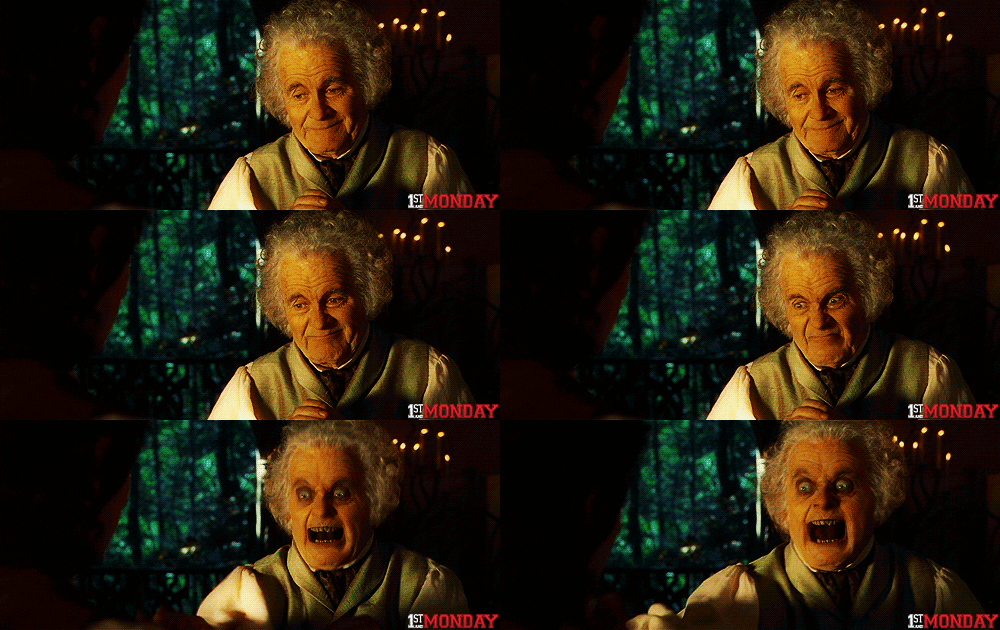
We really try to keep our smartphones away from Mr. 13 Months. He’s elated when he does get his hands on one—usually just for photos or FaceTime—but then turns into Ring Withdrawal Bilbo when we take it away from him. And when he seizes the reins during FaceTime, he generates footage shakier than a Bourne movie, with occasional unflattering but funny shots of his chubby face from below.
Yesterday, though, while on the move with phone in hand, he accidentally opened the camera and managed to take a series of photos documenting his short trip from the hallway to the guest room:
Look at that natural progression from dark to light and from blurry to focused. Perhaps it’s meant to reinterpret common household fixtures in the abstract with askew angles as a comment on our uncertain post-COVID-19 world?
When reached for comment, he said, “*incomprehensible toddler babble*”
Since becoming a patron of Filmspotting on Patreon, I’ve really enjoyed getting ad-free episodes and participating in the production-related chatter.
Recently they were looking for a clever title for a new segment that would be a chronological retrospective of a filmmaker’s work, in anticipation of revisiting Christopher Nolan’s work before Tenet debuts in July. (Assuming, I guess, that we all won’t still be quarantined.)
A few suggestions popped up: Filmography-spotting, Grand Tour, Box Set. Then I added my own: The Oeuvre-view.
I thought that name would have several merits: it’d be fun to listen to Adam and Josh try to pronounce it each time, ‘view’ is related to ‘spotting’, and its double entendre covers the purpose of the project, which is to provide an overview of a filmmaker’s oeuvre.
Cut to yesterday as I listened to the latest episode and heard my name mentioned, along with the fact that Oeuvre-view was the chosen one!
Adam wondered if the title was meant as a joke, but let me reassure you that I consider thinking up punny titles for things my solemn duty. Regardless, I’m honored it was selected and excited for the segment in general.
If you don’t already listen to Filmspotting, get on that. It’s great for both hardcore cinephiles and casual viewers looking for a deeper appreciation of movies old and new.
Thanks to COVID-19, today was my first day working from home. (That’s my new makeshift workspace above, squished into the space between the closet and extra bed in our guest room. I’ve since added a second work laptop.) My library is closed to the public indefinitely, along with most everything else, but as my work mostly happens online I can continue relatively unaffected.
A few days ago I joked that my life isn’t going to change much because all I do is go to work and come home. Thanks to Mr. Almost 13 Months, we don’t travel or have much of a social life. The biggest change will be adjusting my schedule with an active toddler around. But I’m excited for more time with him and my wife and for a much shorter commute.
I feel extremely fortunate to (1) still have a job (2) that I can do from home and (3) will continued to be paid for. I know that’s not the case for many, many people.
Via Kottke, WHO Director-General Tedros Adhanom’s opening remarks at today’s media briefing on COVID-19 officially declared COVID-19 a pandemic. Despite the alarm that word may raise raises, Adhanom concluded his remarks with some wise words:
Let me give you some other words that matter much more, and that are much more actionable.
Prevention.
Preparedness.
Public health.
Political leadership.
And most of all, people.
We’re in this together, to do the right things with calm and protect the citizens of the world. It’s doable.
Burn this into bronze: We’re in this together, to do the right things with calm and protect the citizens of the world. It’s doable.
how the information-collecting missions of the Library of Congress, OSS, and the Allied forces conflicted and aligned before, during, and after the war
how individuals engaged with those missions on the ground
One person’s story that stood out was Maria Josepha Meyer, employed by the Library of Congress and the publisher Hachette to collect books, documents, propaganda, and any other useful material in pre-occupation Paris. When the Nazis invaded in June 1940, she found herself trapped in Paris with no money and an expired passport. She eventually got an export permit from the Germans for her professional library, personal effects, and furniture, and at the last minute swapped her furniture for the war collection she would have been forbidden to ship.
Another was Adele Kibre, an academic who found herself spearheading a clandestine microfilming operation in Stockholm as a way to send foreign publications to OSS for intelligence gathering. Microfilm technology was in its infancy, so quality varied generally. But Kibre’s results were clear and consistent despite her limitations and the secrecy required.
A central figure in the book was Archibald MacLeish, the poet and writer who served as Librarian of Congress from 1939-1944. His work with William Donovan to develop the Research & Analysis branch of OSS helped modernize the Library of Congress and push it beyond the traditional understanding of libraries as neutral providers of books and information.
Peiss:
With the growing international crisis, [MacLeish] raised the stakes for books and democracy, calling upon librarians to be not merely custodians of culture but defenders of freedom. Like Donovan, he had perceived the dangers of fascism early and believed in American intervention. As an artist, intellectual, and the nation’s leading librarian, he was convinced, as he later put it, that ‘the country of the mind must also attack.’
As MacLeigh wrote in 1940, the keeping of war-related records “is itself a kind of warfare. The keepers, whether they wish so or not, cannot be neutral.”
As much as I’d like to view libraries as places that don’t discriminate or take ideological stands, the right to read is itself an ideology, as are the rights to privacy and access. Despite being taken for granted in democratic and literate societies, they must be believed in, fought for, and defended like any other ideology. (Notice too the war-like language.)
Peiss’s book examines how people and institutions reckoned with that dilemma in extraordinary situations. Overall, I found the parts about the people much more engaging than the broader institutional machinations, which often get bogged down in the acronyms and esoterica endemic to academia, government, and the military.
But if that sort of thing is your jam, Information Hunters is right on target.
(See also: The Book Thieves by Anders Rydell and When Books Went to War by Molly Guptill Manning.)
My now one-year-old and I have slowly been going through the episodes of Mister Rogers’ Neighborhood available on Amazon Prime. He’s generally not interested in extended screen time at this point, but Mister Rogers is one of the few figures he recognizes and enjoys. (Along with Alex Trebek. #proudpapa)
There’s not much I can say about Fred Rogers that hasn’t already been said. The man was a genius. And the show, which I hadn’t seen since I was a kid, remains both ahead of its time and outside of it. Its deliberately unhurried pace, humanist ethos, and intellectual respect for its young audience make it almost anti-TV, something I couldn’t have realized as a kid.
Now being on the other side of parenthood, I find watching it a delightful and enriching experience for me and for my son. Rogers’ short bits of wisdom sprinkled throughout the episodes in word and song are deceptively simple, poetic, and actionable. He had such a unique way of communicating that it has its own name: Freddish.
At first I skipped the parts in the Neighborhood of Make-Believe because they’re kinda cheesy. I much prefer Fred hanging around his house doing crafts, singing, and breakdancing. But I’ve come to appreciate how those make-believe times blend the show’s “real” people and plots with the imaginary King Friday XIII and crew.
That kind of magical realism was at the forefront of Marielle Heller’s film A Beautiful Day in the Neighborhood, which is based on the making of Tom Junod’s 1998 Esquire article about Rogers called “Can You Say…Hero?” The movie plays out as one long episode of the show, the main difference being that Lloyd, the Junod stand-in played by Matthew Rhys, finds himself becoming involved in the show. Picture Picture turns into a flashback from Lloyd’s life, and Tom Hanks’ Rogers displays a photo board of characters from the show (which happened on a real episode I watched not long before seeing the movie), one of which ends up being Lloyd.
This blurring of fact and fiction works on two different levels. First, it honors the show’s commitment to showcase real-world experiences alongside its pretend adventures—a dynamic that mirrors the way young children actually experience the world.
Second, it abides by Rogers’ expressed intention to act on the show as if he were speaking to one specific child rather than an audience of millions. He really, truly believed that one person—Lloyd in the movie’s case—was special and deserved his full attention and love. (Aren’t they the same thing?)
That’s the genius of Fred Rogers: he was real, but he seemed magical. He wasn’t a saint, as his wife Joanne explains in the movie. He had to work at being good and getting better just like anyone else. But that’s the kind of neighbor we all should want and aspire to be.
My son walked for the first time today, the day before his first birthday. I was in front of him, bouncing on our exercise ball along to some music (Kira Willey’s “Everybody’s Got A Heartbeat” to be exact). He wanted in on the bouncing action. He was already standing—he’s been standing strongly in place for weeks and walking assisted for longer—so he took three small steps like it was nothing and collapsed into my lap.
I’m glad I was home to see it. I’m glad he did it right in front of me, right to me. And I’m glad my wife had her phone out to record it.
After that moment, I thought it fitting to play “Walking With Spring” by The Okee Dokee Brothers (probably my favorite song of theirs), mostly because of the chorus:
Inch by inch by Foot by foot by Step by step by mile We’re takin’ it inch by inch by Foot by foot ‘Til we find ourselves In the wild
Welcome to the wild, little man.
Scenes from his first birthday party. I guess we were accidentally celebrating something else too.
A new year begins when there’s a memorable change in my life. Not January 1st. Nothing changes on January 1st. … Your year really begins when you move to a new home, start school, quit a job, have a big breakup, have a baby, quit a bad habit, start a new project, or whatever else. Those are the real memorable turning points — where one day is very different than the day before. Those are the meaningful markers of time. Those are your real new years.
I read this just after New Year’s but thought of it recently after noting a significant milestone: Ten years ago this weekend a musical called Tell Me Truly debuted on a stage at my college. It was written and scored by me and my longtime friend, and staged by our friends and fellow students. It was one of the best times and accomplishments of my life.
Ten years is too long and arbitrary a timespan to have any intrinsic meaning to a human brain. My memories of that experience don’t reemerge every year on the anniversary of opening night. They remain with my other “meaningful markers of time” in a bank of memories, accumulating interest as I age and deposit more experiences.
“Memories make us rich,” as the sportswriter Vic Ketchman is fond of saying. In that case, I’m pretty well-off.