• A Different Look at ‘Back to the Future’

    For a college class in winter 2008-09, we had to make a “zine” on a topic of our choice. Mine was called The Movies: Take Two. It aimed to “take a different look” at all things movie-related using crowd-sourced haikus, six-word summaries, and some of my own comparative film analyses to cast some of my favorite flicks in different lights. Usually zines are handcrafted to look purposely shoddy, but since I’m not very crafty I decided to make mine in Adobe InDesign. I still tried to create the haphazard look, but keep it clean at the same time.

    I’ll post the other pages some other time, but today as part of The Simba Life’s weeklong fête of Back to the Future Week, I’m sharing the part of the zine that honored the 1985 classic, albeit in an unorthodox way. Enjoy my reverently rendered irreverence.

    (Click on the image to embiggen)


  • Why ‘Back To The Future’ Still Rules

    To celebrate Back to the Future Week, I’m posting a story I wrote for my school paper in 2008 about my hopeless devotion to the time-bending trilogy.

    If I were asked to name what I think are the greatest films of all time, I might throw out a few high-brow titles like Rear Window or Casablanca or Taxi Driver. But if I had to name my favorite film, one that makes me love movies and makes me love being alive, it would be Back to the Future.

    A silly overstatement, right? Not in the least. I first saw Back to the Future in middle school. Since then it has become my comfort movie. Everyone has one. Everyone has a movie they watch because it reminds them of their childhood or makes them feel happy. My sister watches Seven Brides for Seven Brothers because it got her through the grieving process after our grandma died. I watch Back to the Future because, like all those classic Disney movies, it reminds me of the goodness of my youth. Plus, it is simply a good movie.

    You don’t realize it the first few times you watch it, but Back to the Future is an incredibly well-written movie. There are so many subtle things you don’t notice until you reach the BTTF-nerd status as I have. For instance, the mall is named “Twin Pines Mall” in the beginning. Then, after Marty, played by Michael J. Fox, comes back from the future, it is named “Lone Pine Mall.” This is because he ran over one of the two pine trees in Mr. Peabody’s front yard. (Remember when I mentioned the nerd status? I wasn’t kidding.)

    The writing, especially the dialogue, is exceptionally smart, given that the movie was a big-budget blockbuster when it was released in 1985. The Doc Brown character, played by Christopher Lloyd, has many of the funniest one-liners as the eccentric scientist from the 1950s. He wonders what Marty’s strange suit is and Marty tells him it’s a radiation suit. He responds, “A radiation suit? Of course! Because of all the fallout from the atomic wars.” Later, Marty says his catchphrase “This is heavy” again and Doc wonders why: “There’s that word again: ‘heavy.’ Why are things so heavy in the future? Is there a problem with the earth’s gravitational pull?”

    The acting, as well, is spot-on. But did you know that Michael J. Fox was not originally cast as Marty? Eric Stoltz, who played the drug dealer in Pulp Fiction, was cast first and even filmed a few scenes, but the director Robert Zemeckis fired him (thank God) once Fox found room in his filming schedule for his popular sitcom Family Ties. Christopher Lloyd as Doc and Crispin Glover as George McFly were perfectly peculiar in their roles and Tom Wilson as Biff Tannen created one of the all-time greatest movie bullies.

    But any movie can have clever writing and good casting. What makes me love it so? Honestly, I don’t know. The original music score is wildly fun and the 1950s sets are great bits of nostalgia, but they are just parts of the whole. It just has that X-factor that won’t let me forget how much I love to sit in a darkened room and watch a story unfold. This particular story just happens to zip around the space-time continuum with a slightly insecure, “Johnny B. Goode”-playing teenager and his lovably loquacious scientist friend.

    If I can’t explain why I love the Back to the Future trilogy so much, I can simply show you. In addition to the posters from all three movies hanging on my wall, I have three different DeLorean die-cast, 1:18 scale model cars (one from each movie) and a pen and a key chain I bought from Universal Studios after taking the now-defunct BTTF ride. Yet my nerdness runs deeper: I also have a copy of the letter Marty writes to Doc which I made myself in junior high pinned to my bulletin board at home. Yeah, that’s right.

    But the most amazing experience I’ve had with Back to the Future had nothing to do with the movie itself. When I was in eighth grade, my dad met a guy who owned a real DeLorean and asked him to dress up like Doc Brown, crazy wig and all, and cruise down my street and into my driveway. He leaped out of the car and yelled, “Chad, you’ve got to come back with me! Back to the future!” I jumped in the car and we drove around the city like crazy time-travelers. It was an otherworldly experience. (I now realize I never thanked my dad for. Thanks, Dad!)

    To me, Back to the Future represents the incredible power of cinema. I feel like I take in the world through my senses when I watch it. I know that sounds crazy, but I can’t describe it any other way. I know that every one of us has a book or a movie or a song that has an invisible hold on our hearts and souls. Mine just happens to rock along to “Power of Love” by Huey Lewis and the News. I wouldn’t have it any other way.


  • Steve Jobs Lives

    This 1987 concept video from Apple predicts not only the iPad and all of its capabilities, but also Siri, the speech-activated personal assistant that will be ubiquitous technology in a few years given how Apple products usually work. (H/T to Andrew Sullivan for the video)

    Andy Baio finds this amazing:

    Based on the dates mentioned in the Knowledge Navigator video, it takes place on September 16, 2011. The date on the professor’s calendar is September 16, and he’s looking for a 2006 paper written “about five years ago,” setting the year as 2011. And this morning, at the iPhone keynote, Apple announced Siri, a natural language-based voice assistant, would be built into iOS 5 and a core part of the new iPhone 4S.

    So, 24 years ago, Apple predicted a complex natural-language voice assistant built into a touchscreen Apple device, and was less than a month off.

    I never had the emotional attachment to Steve Jobs as many others around the web have been describing, but I do use his products. The iPhone, Macbook laptop, and the iPod seem so ordinary now, but 24 years ago who could have predicted how they would change the world as they did? I suppose that’s the best compliment you can give a technology geek like Jobs – that what he did changed the world for the better.


  • Rufus Saxton

    Part of the Cool Civil War Names series.

    Saxton was, in the argot of youth, the bomb diggity. A Massachusetts native, his father was a transcendentalist, feminist, and abolitionist, which helped form Rufus’ anti-slavery sentiments from a young age. He graduated from West Point eighteenth in this class, then spent the rest of his antebellum days fighting the Seminoles in Florida, teaching at West Point, and surveying the Rocky Mountains for the Northern Pacific Railroad with none other than Mr. It’s-Everyone-Else’s-Fault, George McClellan.

    And then, as the future Great Emancipator said, the war came. Saxton joined up with McClellan’s staff until partaking in what would become a pivotal moment in his career: leading a defense as brigadier general at Harper’s Ferry to push back Stonewall Jackson’s Shenandoah campaign. Saxton would receive the Medal of Honor for his work there, specifically for “distinguished gallantry and good conduct in the defense.”

    But he didn’t stop there. Tasked with raising the first regiment of liberated slaves, Saxton put together the 1st South Carolina Colored Volunteers and helped organize the post-Emancipation recruitment of black soldiers. He continued along this line of work until the war ended, after which he gradually moved up the ranks before retiring to Massachusetts a colonel and all-around cool guy.

    Up next in CCWN, the je ne sais quoi JUBAL EARLY.

    (source: 1, 2)


  • Samuel C. Pomeroy

    Part of the Cool Civil War Names series.

    You get the feeling like this guy was the Mitt Romney of the Civil War era, because he did some good things but then kept managing to screw himself over. Born in Massachusetts, he served in the state House of Representatives for one year before joining ranks with the anti-slavery movement. But he wasn’t some foot soldier; after the Kansas-Nebraska Bill was passed he up and moved to Kansas as part of the abolition crusade and employee of the New England Emigrant Aid Company. He also served as a town mayor and helped out with famine relief in 1861.

    If only he’d stopped there. Because throughout the ’50s and through the Civil War as well, Pomeroy got involved in a lot of shady investment deals with railroads, coal mines, bridges, etc., so much so that the 1860 federal census in Kansas called him “The Speculator.” The problem with all this is when he tried to run for Senate, he’d already made a lot of enemies. Money quote from one of those enemies, John Ingalls: “If abdomen was a test he [Pomeroy] would be sure to triumph, but as brains enter into the contest some what, his chances are small.”

    Still, he was selected in 1861 and served until 1873 when he was accused of buying votes in the legislature and replaced as senator by none other than John Ingalls. Ouch.

    The man lives on, though, as the fictionalized inspiration for a corrupt politician in Mark Twain’s The Guilded Age. Can’t get much better than Mark Twain, right?

    Up next in CCWN, the stouthearted RUFUS SAXTON.

    (source: 1)


  • Zebulon Baird Vance

    Part of the Cool Civil War Names series.

    This guy had ambition. Studying law by 21 and in the North Carolina House of Commons by 24, Vance made friends and won elections with his oratorical skills and soon entered Congress as the youngest legislator and one of the few Southern supporters of the Union. This is 1860, mind you, and Vance’s fire-breathing neighbors to the south are calling for secession. Yet once his home state voted in favor of it, he resigned his seat and returned and raised a company of soldiers dubbed the “Rough and Ready Guards.” He fought his way up to colonel and by 1862 was on the gubernatorial ballot as the “soldier’s candidate.” It’s tough beating a popular soldier during wartime, so he won handily and left his regiment just before it was decimated at Gettysburg.

    His time as governor was noteworthy for a few reasons: he pissed off the Richmond crew because of his insistence on local self-governance, meaning he didn’t always play along with the rest of the Confederacy. North Carolina was the only rebel state to keep its civilian courts open and observe habeas corpus, and Vance refused to let blockade runners pass through until Carolinians had their share. That was all well and good until the war ended and Vance was arrested and imprisoned for a time (that whole rebellion thing usually backfires). No worries though – he was paroled eventually and went back to governating to much popular acclaim.

    Up next in CCWN, the scandalous Samuel Clarke Pomeroy. 

    (Source: 1) (Image credit)


  • Lambdin Purdy Milligan

    Part of the Cool Civil War Names series.

    This guy’s tale helps puncture a few holes into the Abraham Lincoln Was An American Jesus Who Was Perfect In Every Way story that kids get fed in grade school. Milligan was a lawyer from Indiana (who had actually taken the bar exam with future Secretary of War Edwin Stanton), who held fervent anti-Union views that were pretty commonplace where he was living in northeastern Indiana. The problem was Milligan and some compadres took their views to another level by plotting in 1864 to steal weapons and free Confederate prisoners of war.

    Now Lincoln, who by this time in the war had become quite adept at locking up rabble-rousers and outspoken critics under questionable Constitutional authority, took things a little too far with Milligan and his crew. The men were tried in a military tribunal and sentenced to death, which was a big Constitutional no-no for regular citizens so they appealed for their right to habeus corpus. Since Indiana wasn’t under attack, Milligan wasn’t involved with the military, and the civilian courts were up and running at the time, the Court swatted Lincoln back a little bit and released Milligan. He later sued the General who tried him in the tribunal for libel and false imprisonment, asking for $500,000 in damages. He got $5. Ouch.

    But get this: the Supreme Court Justice who wrote the majority opinion of his case – David Davis – was a Lincoln appointee and close friend. He even chaired Abe’s 1860 campaign. Very ouch.

    Bonus trivia: One of Lambdin’s lawyers in his first trial was future U.S. president James Garfield, and the lawyer who represented the General in the libel case was future U.S. president Benjamin Harrison.

    Up next in CCWN, the zealous ZEBULON BAIRD VANCE.

    (sources: 1, 2)


  • Clement L. Vallandigham

    Part of the Cool Civil War Names series.

    Opinions abound about this guy, but I think the nickname Lincoln gave him describes him best: the Wily Agitator. An Ohio-born lawyer and Congressman with Southern ancestry, Vallandigham took it upon himself to lead a crusade against the anti-slavery Republican Party before and during the war and assumed leadership of the Copperheads, a coalition of pro-Confederate Northern Democrats who wanted to settle with the CSA and generally make Lincoln’s life miserable.

    It’s one thing to lead the opposition; it’s quite another to be a dick about it. Vallandigham vocally hoped for Northern defeat and threw all kinds of hyperbolic vitriol at Lincoln and the North. He eventually pissed one too many people off and got himself arrested and jailed for sedition. But Lincoln of all people commuted his sentence to banishment to behind Confederate lines. Yet instead of staying below the Mason-Dixon, Vallandigham took to Canada, where he declared himself a candidate for Ohio governor. He might have won if not for Union victories at Gettysburg and Vicksburg in mid-1863. He kept up his opprobrium against Lincoln, but ol’ Abe decided not to arrest him again and instead let him shoot himself in the foot. It worked because the 1864 Democratic platform, which Vall helped write, failed spectacular in the election when Lincoln was decidedly reelected.

    The strangest part of his story, though, was its end. Vallandigham ACTUALLY SHOT HIMSELF in 1871 during a trial while trying to prove his client’s innocence. The client walked free, but Clement did not. Karma’s a bitch.

    Up next in CWWN, the law-breaking LAMBDIN P MILLIGAN.

    (source: 1) (image credit)


  • Sylvanus Cadwallader

    Part of the Cool Civil War Names series.

    Probably my favorite name thus far. A true journalist during a time when mainstream journalism consisted of BRASH, HYSTERICAL HEADLINES!!! and Limbaughesque vituperation, Cadwallader began his newspaper career in Milwaukee before joining the Chicago Times and later the New York Herald as a war correspondent embedded with General Ulysses S. Grant. (He wrote about this time in Three Years With Grant, an acclaimed postwar memoir.) He followed Grant for three years through critical campaigns in Mississippi and Tennessee, during the advance on Richmond, and was present at Appomattox for the peace treaty signing.

    He’s also the source of the hotly debated claim that Grant was drunk during the Vicksburg campaign in 1863. Embellishment or fact? Who knows. What we do know is Grant sent Cadwallader a letter in September 1864 commending him for his reporting. Clearly “Unconditional Surrender” Grant wasn’t too upset with him.

    After the war, Cadwallader served as a public official in Wisconsin before retiring to California to write his memoir. I haven’t read it yet, but the scant information about him that’s available tells us his journalism was exemplary simply because he wasn’t a fire-breathing partisan like many of his colleagues. A low bar, it seems, but he passed it.

    Up next in CCWN, the churlish CLEMENT L. VALLANDIGHAM.


  • Leonidas Polk

    Part of the Cool Civil War Names series.

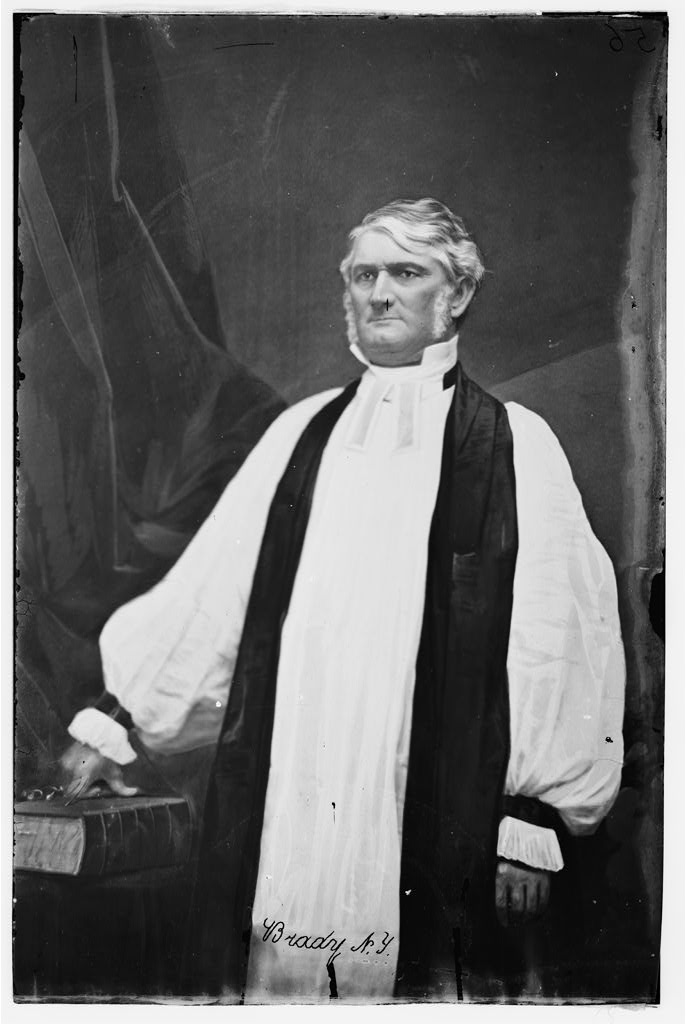
    Leonidas Polk was many things: a West Point graduate, founder of The University of The South (Sewanee), the second cousin of President James Polk, and an Episcopalian bishop. He was also a terrible field general. He was a typical example of a Civil War “political general”, a man who had little or no combat experience but was given (or demanded) a political appointment from someone in power, who in Polk’s case was the Confederate’s big dog himself, Jefferson Davis.

    Polk didn’t demand the job; he just offered his services to Old Jeff, who dispatched him to the Tennessee Valley. He hopped around Tennessee and Mississippi, all the while butting heads with General Braxton Bragg, who called Polk “an old woman… utterly worthless” but knew he couldn’t shake him because Jeff Davis loved him. Didn’t matter for too long, though, because Polk was killed in June 1864 when General William Tecumseh Sherman (of The March to the Sea fame) spotted him hanging with other officers and shelled them.

    It’s important to note that while Polk, despite graduating from West Point eighth in his class, was not a good battle tactician, he was loved by his troops. His nickname was “The Fighting Bishop” for obvious reasons, and to one Confederate private his loss was second only to Stonewall Jackson. I’m sure there are many other examples of clergymen becoming soldiers, but Polk was one of the more controversial ones.

    Next in CCWN, the sagacious SYLVANUS CADWALLADER.

    (source: 1) (Image credit)


  • Cool Civil War Names: a preamble

    Awhile back I read James McPherson’s Battle Cry of Freedomthe sixth volume in Oxford University Press’s ongoing series of American history. (The full series list is worth checking out if you’re ever in the mood for thousands of pages of U.S. history—and who isn’t?) I learned a lot of things from McPherson’s tome, but most salient was that the men who fought the Civil War had really, really cool names.

    I noted my favorites from the book, found a few more, and decided to write a little about each of the men they’re attached to in a miniseries called Cool Civil War Names. Many are soldiers, others journalists or public figures. Together, they tell the story of the era that gave this nation its most fiery trial—and its most fantastical facial hair.

    The Names


  • Dig A Little Deeper

    Hope is not a future-minded reverie or escapist dream, but rather a call to action to order the disordered, right the wrongs, and fix what we can in the here-and-now, even if it’s always just scratching the surface.

    –Brett McCracken, in a wonderful post on hope and cynicism. There’s certainly plenty in our world to be cynical about, but still more about which to be hopeful. We’ve just got to dig deeply.


  • Love and Illusion in ‘Midnight In Paris’ and ‘Me And Orson Welles’

    Is this the real life? / Is this just fantasy? / Caught in a landslide / No escape from reality / Open your eyes / Look up to the skies / And see.
    “Bohemian Rhapsody” by Queen

    A few summers ago I was in Guatemala with my sister, staying with an older married couple near the Pacific coast. Over lunch one day they asked me what traits I desired in a future spouse. They asked about height, hair color, personality, etc. and I told them what I liked. That’s all great, said Alvira, the wife and homemaker, “But remember, don’t look for the ideal girl; look for the real girl.”

    This dichotomy of ideal versus real stuck with me. We all have things in our lives we wish were real but are actually illusions. Think about your favorite movies, books, or TV shows. Don’t you wish you could live in those worlds? You can, for a time, but eventually the story ends and the illusion fades away.

    But what if we tried to hold on to these ideals, these stories we tell ourselves, because they’re beautiful or inspiring, even though they’re ultimately temporal? This is a question both Gil from Woody Allen’s Midnight in Paris (2011) and Richard from Richard Linklater’s Me and Orson Welles (2009) struggle with in their encounters with the ephemeral.

    Neither Richard nor Gil are satisfied. Gil (Owen Wilson) is a self-described “hack” Hollywood screenwriter who vacations in Paris with his fiancée Inez (Rachel McAdams) and her parents. A neurotic and a romantic, he’s stuck between his obligations to the lifestyle Inez wishes to keep up and his newly kindled desire to finish his long-dormant passion project – a novel about a man who works in a nostalgia shop specializing in memorabilia from 1920s Paris.

    Here, as they say, comes the turn. In a twist of fate, Gil arrives at a bar, circa 1928, filled with rowdy patrons resplendent in classic Twenties dress. He bumps into a Zelda Fitzgerald and her husband Scott. Cole Porter croons from the piano. He later meets a broody writer named Ernest Hemingway, who after learning Gil is a writer, offers to give his manuscript to Gertrude Stein. For some reason, he’s come face to face with all of his literary idols.

    Meanwhile, in late-1930s New York, Richard (Zac Efron), a bored high-school student, meets by chance the famous theater wunderkind Orson Welles. Welles needs a ukulele player for his oft-delayed production of Julius Caesar at the Mercury Theater and finds Richard suitable for the show, which is supposed to open in days.

    Like Gil, Richard soon finds himself in another world, performing beside the larger-than-life and mercurial Orson Welles, who runs rehearsals pell-mell yet commands great respect from his colleagues in spite of his massive ego. Richard grows close to Sonja (Claire Danes), Welles’ hard-to-get secretary, and soon considers her his lover. For Richard this is the ideal life: performing on stage far away from his boring family and school.

    Gil, too, grows close to a woman in his otherworld. Adriana (Marion Cotillard), a beautiful fashion designer, shares his romanticism and validates Gil’s desires more than Inez ever did. He falls hard for Adriana just as he falls further away from Inez.

    But sooner or later, the illusion evaporates. Sonja, ambitious above all else, sleeps with Welles the night before the opening. Too jealous for his own good, Richard castigates the thin-skinned Welles, who in turn fires Richard. They make nice before the show and perform it splendidly, but Richard later learns Orson “just wanted his opening,” so Richard’s out for good.

    Gil has a different kind of clash. Adriana doesn’t share his love of the 1920s because it’s her present. “It’s dull,” she says. She much prefers La Belle Époque, Paris’ Victorian era of the 1890s. This triggers Gil’s light-bulb moment: everyone thinks the past era was better than his or her present. Another character in Midnight in Paris calls it “Golden Age thinking.”

    So whether out of naiveté or misplaced optimism, they finally awake from their dreams. Yet even in their dreams, both men had brushes with reality. For Richard, it was Greta, a girl he meet-cutes in a music store. For Gil, it was Gabrielle, a flea market vendor selling Cole Porter LPs. They talk briefly each time about music and art, but the thing about these women compared to the ones in their fantasies is that they’re real. Gabrielle isn’t the stunner of Gil’s dreams like Adriana was; she’s flesh and blood. She may not inspire great works of art with her beauty, but she loves walking in the rain just like Gil does. Greta doesn’t work in a grandiose theater production like Sonja; she’s a struggling writer who connects with Richard away from the spotlight.

    Gil and Richard never had a chance at their dream women because they didn’t actually exist. They may have been real for a time, but only for a time. That’s the problem with illusions; they don’t last forever. A connection with real life – with Gabrielle and with Greta – made them realize that.

    The ideal is temporary, but fools you into thinking you can have it all and keep it that way. The real, conversely, is tangible, yet can fool you into thinking life is dull because it isn’t always enchanting. We find fulfillment in the ideal because it lets us escape from an undesirable present. But Gil realizes eventually that “the present is a little unsatisfying because life is a little unsatisfying.” No illusion will ever change that.

    This isn’t a depressing thought. In fact, it can set you free. To paraphrase the wise old thief from The Italian Job, you can either let the illusion enhance your life or define it. Don’t let it be the latter.

    So we need not shatter our illusions completely. At their best, illusions are simply stories that can inspire, inform, and reveal beauty to us in many ways. When we let these stories enhance our lives rather than define them, real, amazing things can happen.

    At the end of Welles, Richard, a little blue after losing his dream job, the illusion shattered, meets Greta at the museum again. Her short story is being published, and Richard is finally clear-eyed about his life.

    “It’s an exciting time,” Greta says, “because it feels like…”

    “Like it’s all ahead of us,” says Richard.

    This is the real life.


  • Dodging Dogma

    I’ve been reading Colonel Roosevelt, volume III of the Edmund Morris’ TR trilogy, and one line came back to me after seeing Ezra Klein’s pie chart illustrating, in the midst of a debate to strip Planned Parenthood of funding as a prerequisite for not shutting the government down, what the organization actually does.

    Morris’ line from the book comes after describing Roosevelt’s impatience for the “interfaith squabble” going on at the time in Egypt between Muslims and Coptic Christians. In Roosevelt’s view,

    Their inability to tolerate each other proved the necessity of condominium with the British, who at least had advanced far enough into the modern age to know there were more important things than dogma.

    Emphasis mine. The looming government shutdown puts at risk the very important resources that Planned Parenthood provides for many poor, pregnant, cancer- and STD-stricken people, with little money and less hope. It’s not about abortion. If the church isn’t willing to help these people like they should be helped, then the church has failed.

    There are more important things than dogma. Unfortunately, that’s all it’s been about.

    [Image: WPost / HT: TDW)


  • Mad World

    Looks like Mad Men is getting the LOST treatment, and I couldn’t be happier about it. The deal between Mad Men showrunner Matthew Weiner and AMC will end the series after the sixth season premieres. Like the deal that gave LOST a definitive end-date a few years ago, this new deal for Mad Men will be very beneficial, I think, to the show and the fans.

    Though, Mad Men isn’t floundering in its storytelling at this point as LOST was at the end of season three. It’s only getting better.


  • Here And LeClaire

    I spent part of the weekend in Iowa with my dad. We made a pilgrimage of sorts to Antique Archaeology in LeClaire, the home base of the antique-scavengers featured in the show American Pickers. Didn’t end up selling anything, but it was cool to see their place, which, as my dad reports, is much smaller than it looks on television.

    We also got to tour the Mississippi River Distilling Company, a local spirits distillery. They explained the distilling process for vodka, gin, whiskey, etc., and how their “grain to glass” process is one of only a handful in the U.S. Every step of the process is handled using locally-made products, from the corn and wheat to the wooden barrels and glass bottles. They took pride in their unique flavor, which was the result of putting the drink through the distilling process only once rather than multiple times, as is the case with most other vodka manufacturers. They’ve only been in business for three months, but it looks like they’re doing well.

    LeClaire is also the childhood home of Buffalo Bill Cody, so we toured the museum in town, which ended up being less about Buffalo Bill and more about the town itself. With its strategic placement on the Mississippi, LeClaire saw a lot of riverboat steamers pass through back in the day. They have one on display in the museum – the Lone Star – which is the last remaining, fully-intact example of the wooden-hulled riverboat design typical of that era.

    Finally, we drove the half-hour down the river to Davenport to see the Titanic artifact exhibit at the Putnam Museum. The exhibit integrated the artifacts with the story of the ship’s creation and first and final voyage. Most eye-opening was the wall of survivors and perished. They divided the passengers list by class – 1st, 2nd, 3rd, and crew – and the percentage of 1st class passengers saved compared to that of 3rd class and crew was stunning. At least 60-70% of first-class passengers were saved, while the reverse was true of the lower classes. Class status, generally speaking, really did determine whether they would live or die.

    I’ve never actually stayed in Iowa, but I thoroughly enjoyed the stereotypical yet still very real Midwestern small-town charm. I also have a recharged desire to go to more museums and historical sites. Can’t get enough of those.

    (Photo: Matt Heeren)


  • There’s No Felling This Forrest

    Can’t say that I’m a big fan of the results of this new poll from The Telegraph, in which voters named Forrest Gump the greatest movie character of all time, with James Bond, Scarlett O’Hara, Hannibal Lecter, and Indiana Jones filling out the top five.

    While I know some lists are entirely unserious affairs, the fact that Bond, O’Hara, Hannibal the Cannibal, and the Raider of the Lost Ark were beat out by, let’s be honest, an anodyne dolt who is not in the least bit as interesting as any of the other runners-up is confusing and a little disheartening.

    Great movie characters aren’t colorless, Rorschach-like stand-ins who just let their circumstances and events of the day passively happen to them – however memorable or pivotal the events – as is the case with Forrest Gump. Great movie characters have color, and they make their own life happen. They go out a risk life and limb to find the Ark of the Covenant, to sail a house with balloons to South America, to fight crime while web-slinging through the streets of New York.

    Great characters do something. Forrest does stuff, sure. But, man, is he boring while he does it.

    Let’s be clear: I love Forrest Gump. I don’t have to love the character to love everything else about that film. And I guess it says something about the enduring appeal of the film that Gump can show up on a poll like this almost two decades later. But do I think he’ll be on the same poll over 70 years after the film’s release, like Scarlett O’Hara from Gone With The Wind is?

    Frankly, my dear, I think not.


  • Straight Huck Express

    Something I’ve always liked about Mike Huckabee is his candor and generally pragmatic sense, which were on display in a recent interview with GQ:

    Compare yourself to Sarah Palin and Mitt Romney. Do you think you’re more center right?
    I think my political philosophies are solid, traditional conservative. It’s not that I’m a moderate, even though I’ve been called that. In the course of governing a state like Arkansas… I learned that you don’t get your way all the time. There may be some things that are very important to you. You have to figure out how you can get those things done and, at the same time, let the folks from the other side get some things that they want without compromising your core values. One of the things that concerns me—particularly about the atmosphere in Washington—is that I fear we are becoming an ungovernable country. You can campaign with bumper sticker absolutism. You can’t govern that way.

    The 2012 Republican field remains to crystallize, but if Miss Wasilla deigns the presidency to be beneath her I’d like to see Huckabee in the fold – if only to have some legitimate cheerfulness in the Republican mix.