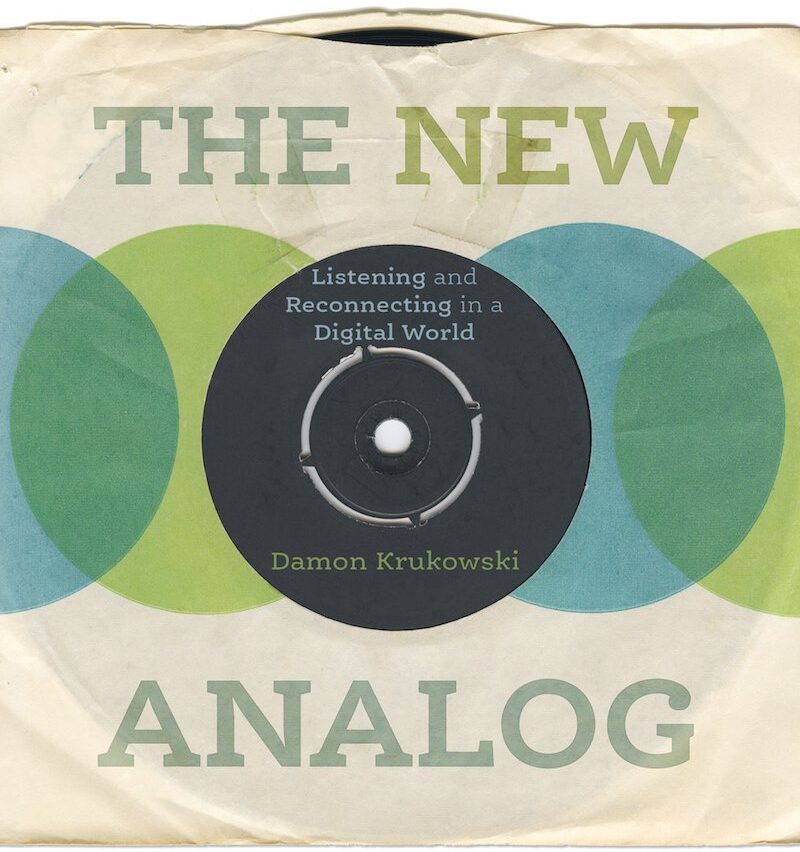
“Thank you for reading this analog book. It requires no additional hardware, uses no power, and is 100 percent recyclable.”
“The author and publisher of this book do not have any information about you; they do not even know that you have a copy of this book unless they sent it to your personally.”
“Noise is as communicative as signal.”
Early 20th century: “playing music” = listening together
early photographs are loud, without volume control (hence phrase “put a sock in it”
“An effort to define aspects of the analog that persist—that must persist—that we need persist—in the digital era.”
Without means of musical escape in public in 1970s, much more of a shared space –> now, “how many riders remain in just a single time and space?”
We occupy space simultaneously but not together
Distracted bicyclist with headphones, headphones = signal only. “The problem was that she had stopped paying attention to the noise.”
Spatial hearing depends on shifting definition of signal and noise—dependent on both
In “Dial M for Murder”, Milland’s phone call was listening to noise—important
“Digital black” of cellphone silence = absence of noise
beamforming: preferential listening from special direction
Noise created by old analog phone system represented distance, was “an artifact of that distance”
New phone mics limit range of sounds and flatten voice sounds
“The voice…can only be heard, never felt.”
Lack of proximity effect extends to Facebook posts, tweets, Instagram photos
“Digital media allow for clear communication across great distances, but communicating distance itself becomes a challenge. Everyone is in the same spatial relationship to everyone else. Proximity effect has been eliminated.”
Sidetone: sensory feedback of our own voice heard by our own ears (monitor)
“when we can’t hear ourselves we can’t modulate our voices.”
Noise = nonverbal aspects of our voices
“Analog sound reproduction is tactile”
“Friction dissipates energy in the form of sound”
Surface noise and tape hiss aren’t flaws but artifacts of their use. They are the “sound of time”, like clock gears
“What is music but sounds in time?”
Player pianos sued by publishers in 1908 but lost. Copyright (C) only applied to text around the sound (sleeves and labels), not sound itself (P) (phonogram)
Then Napster sued in 1999 because it had severed the text from the sound, which iTunes then did officially in 2001. “Digital music is all (P): sound you cannot touch.”
Records: solid slabs of time; tape: cut into pieces
Death-obsessed Victorians saw sound recordings as preservation—embalming
Abundance of digital music creates time deficit
“Thick listening”: alert to depth of layers
listening to signal framed and enriched by noise
“Streaming is a medium for ahistorical listening.”
stripped of context, it’s all (P)
Pandora created its own taxonomic metadata, trademarked; treat liner notes as noise
“Simultaneity can only be an approximation in digital media… Analog time is shared history—it is lived time.”
Noise: the space between us, the distance between us
“Noise doesn’t want to be free. Maybe it even wants to be expensive.”
Cocooned in nothing but signal
Isolated and commodified signal is a “locus of digital power and profit”