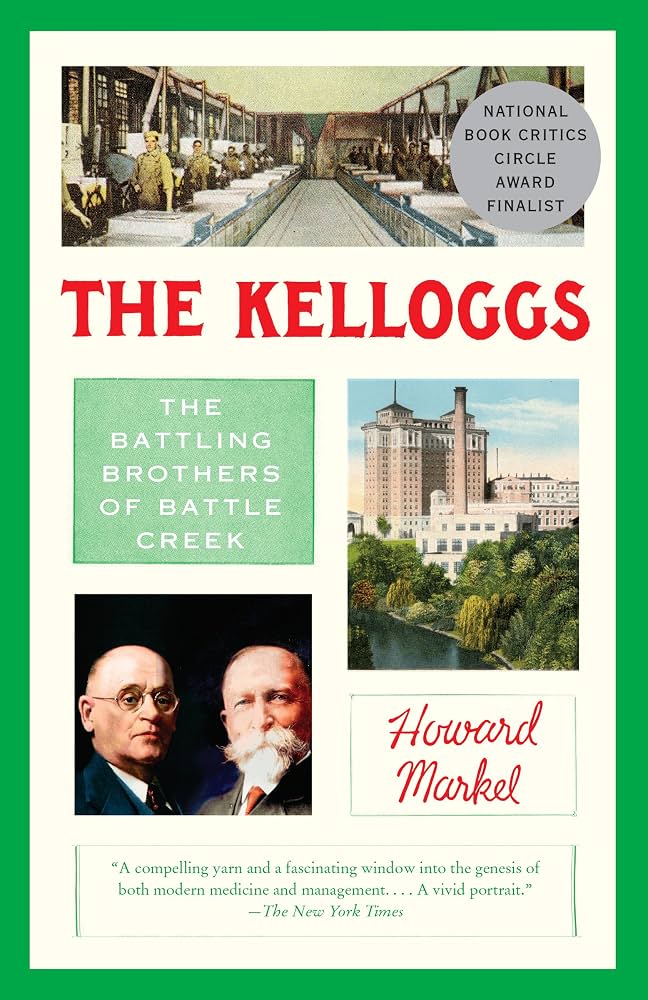
Parents settled in pioneer Michigan in 1830s
Mother died when three kids were young; father John Preston remarried family friend Ann Janette at 18 soon after
John was sickly runt suffering from anal fissures among other things; explains his later obsession with colon hygiene
Parents very involved in apocalyptic Seventh-day Adventist movement and church life
Religious upbringing and pioneer toil formative for John; despite later flaws, retained Christian spirit and service
Selection as “printer’s devil” (apprentice) for church’s publication led to skill and appreciation for writing
Common of era to overeat meat, salt, and sugar, leading to sundry indigestion issues
Sylvester Graham among prominent Christian health reform advocates, inventor of graham cracker and proponent of extreme sexual purity
Russell Trall another reformer and founder of Trall Hygeian Home (precursor to Battle Creek sanitarium); more liberal on sexuality (called exercise the “movement cure”)
John began studying medicine at Ann Arbor, but poor education propelled him to Bellevue hospital college in New York
Will hated his name but loved 7 numerology; bullied and tattled on by John and put down by father; considered “dull” in school but was actually nearsighted; insecurity and expressionless face compounded by bad teeth
Will started out as kid doing work in father’s broom factory, then as teenager became traveling salesman
In 1876, 16% of Bellevue patients died, often by infection or surgery; in ER a sign said “prepare to meet your god”
John had lightbulb moment of prepared cereals as broke med student in New York
His dissertation concerned the nature of disease and insistence of avoiding toxic drugs in favor of preventative diet and lifestyle
Will toiled at broom business before getting accelerated business degree and getting married at 20 in 1880
John appointed director of what became Battle Creek sanitarium and hired Will as manager of publishing and food businesses
“The best remedy for “the blues” is to turn one’s face resolutely toward better things.” -John
Henry Crowell, Christian businessman, began manufacturing Quaker Oats in 1883 in Ohio; Henry Perky (Shredded Wheat) and Charles Post also competitors
John corresponded with Russian doctor Ivan Pavlov on physiology of digestion
John’s quest for easy digestibility with Corn Flakes ironically created pre-digested cereal that boosts sugar
John offered to buy Perky’s Shredded Wheat but then backed out; big regret, but eventually won when sued by Perky for trademark infringement
John and Ella probably never consummated marriage due to his extreme views on sexuality; fostered and adopted several dozen kids over the years
By 1902 Battle Creek hosted “gold rush” of cereal opportunists
Post making millions off corn flakes ripoff and Grape Nuts, but health issues led to shooting himself in 1914
Will developed corn flakes from flaking grits and added sweeteners much to John’s chagrin
Will left the San in 1901 to focus on the cereal business, but after it burned down six months later he came back
Burn possibly caused by Whites, who’d grown resentful of John’s imperial ways
Rebuilt much bigger San and was severed from the church in 1907
First hired contractor surgeons but poor work inspired John to develop own skills and in-house, all while running San, writing and lecturing, meeting patients
Studied other surgeons and adopted gynecologist Lawson Tait’s antiseptic surgical techniques that led to unprecedented streak of infection-less operations; gained acclaim and operated until age 84
Third to half of his surgery patients weren’t billed due to poverty; would charge rich more to balance
Would perform womb massages himself often; unknown medical reasons, but women liked them
Will ran operations of San’s expansive grounds, applying Taylorite scientific management principles
Business advisor Arch Shaw stumbled upon the San and sold Will ledger system in 1897; later became advisor and board member for cereal
San audited by bank in 1907: found poor conditions, inefficient employees, and no authority structure after Will left; John a gifted physician and inventor but bad manager
Ahead of his time on dangers of sitting (had special chairs in the San that promoted good posture), meat (in time of poor manufacturing), smoking (along with Henry Ford), and exercise
Virulently anti-masturbation, to the point of circumcising recidivists of both genders; STDs and sex-as-dirtiness factors
Railed against oysters, leading to censure from Maryland legislature, though Will was fan
Famous friends and patients included Ford, Ida Tarbell, Amelia Earhart, Rockefeller Jr, Barron (WSJ), Coolidge, Taft, WJ Bryan
Will took out ads in Ladies’ Home Journal and create false scarcity to compel women to have their grocers carry Corn Flakes; same for Rice Krispies in 1928
Providential that rise of Corn Flakes aligned with increasingly widespread accessibility of clean pasteurized milk
During Depression Will switched from three 8-hour shifts to four 6-hour to avoid layoffs
Will stepped down in 1939 at age 79; replacement Vanderploeg introduced sugary cereals Sugar Smacks and Frosted Flakes and hired Leo Burnett in 1949 to create characters
Sued each other throughout the 1910s over competing cereals and brand names; eventually Will won both
John a prominent backer of eugenics movement; though well regarded for treatment of Battle Creek African-American population, advocated inferiority of negro race
Will’s son John invented the wax paper bag inside the cereal box to maintain freshness
John was more famous than his various businesses, but Will the opposite
Post-mortem psychoanalysis branded Will with inferiority complex, deep-seated unhappiness, but satisfaction in benefiting humanity
San board expanded facilities right before Depression against John’s wishes; went into receivership, then reorganized to cut out John
Irony of their unhealthy rancor contrasted with their “better living” missions