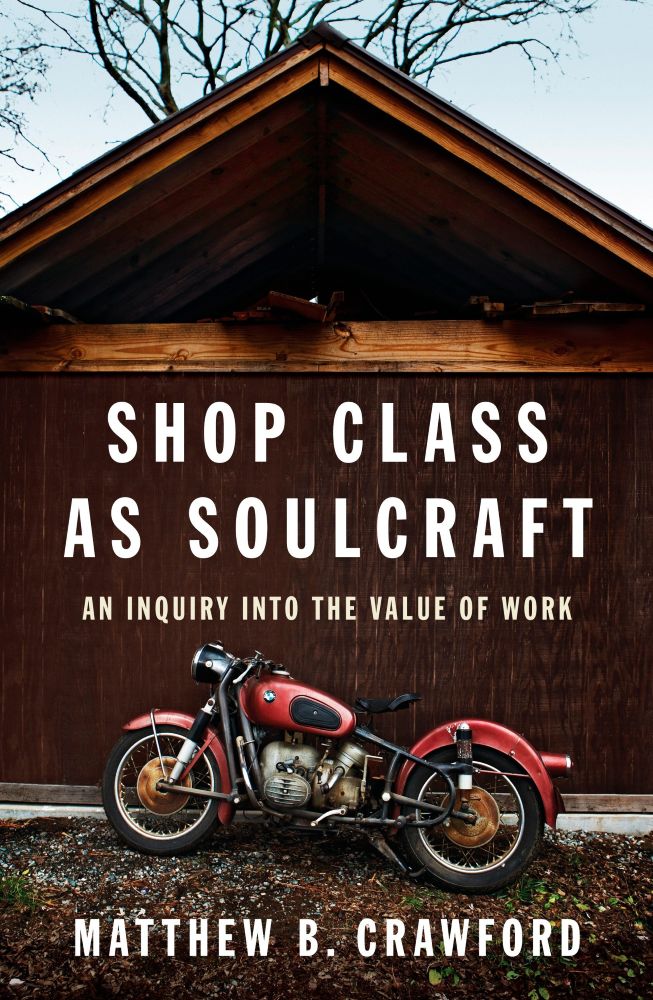
“Neither as workers nor as consumers are we much called upon to exercise such competence, most of us anyway, and merely to recommend its cultivation is to risk the scorn of those who take themselves to be the most hardheaded: the hardheaded economist will point out the ‘opportunity costs’ of spending one’s time making what can be bought, and the hardheaded educator will say that it is irresponsible to educate the young for the trades, which are somehow identified as jobs of the past. But we might pause to consider just how hardheaded these presumptions are, and whether they don’t, on the contrary, issue from a peculiar sort of idealism, one that insistently steers young people toward the most ghostly kinds of work.”
“This book advances a nestled set of arguments on behalf of work that is meaningful because it is genuinely useful. It also explores what we might call the ethics of maintenance and repair, and in doing so I hope it will speak to those who may be unlikely to go into the trades professionally but strive for some measure of self-reliance—the kind that requires focused engagement with our material things. We now like our things not to disturb us. Why do some of the current Mercedes models have no dipstick, for example? What are the attractions of being disburdened of involvement with our own stuff?”
“We often hear of the need for an ‘upskilling’ of the workforce, to keep up with technologically change. I find the more pertinent issue to be: What sort of personality does one need to have, as a twenty-first-century mechanic, to tolerate the layers of electronic bullshit that get piled on top of machines?”
“Frugality may be only a thin economic rationalization for a movement that really answers to a deeper need: We want to feel that our world is intelligible, so we can be responsible for it. This seems to require that the provenance of our things be brought closer to home. Many people are trying to recover a field of vision that is basically human in scale, and extricate themselves from dependence on the obscure forces of a global economy.”
“The meta-work of trafficking in the surplus skimmed from other people’s work suddenly appears as what it is, and it becomes possible once again to think the thought, ‘Let me make myself useful.’”
“Boasting is what a boy does, because he has no real effect in the world. But the tradesman must reckon with the infallible judgment of reality, where one’s failures or shortcomings cannot be interpreted away. His well-founded pride is far from the gratuitous ‘self-esteem’ that educators would impart to students, as though by magic.”
“Constantly seeking self-affirmation, the narcissist views everything as an extension of his will, and therefore has only a tenuous grasp on the world of objects as something independent. He is prone to magical thinking and delusions of omnipotence. A repairman, on the other hand, puts himself in the service of others, and fixes the things they depend on. His relationship to objects enacts a more solid sort of command, based on real understanding. For this very reason, his work also chastens the easy fantasy of mastery that permeates modern culture. The repairman has to begin each job by getting outside his own head and noticing things; he has to look carefully and listen to the ailing machine.”
“The craftsman’s habitual deference is not toward the New, but toward the objective standards of his craft. However narrow in its application, this is a rare appearance in contemporary life—a disinterested, articulable, and publicly affirmable idea of the good. Such a strong ontology is somewhat at odds with the cutting-edge institutions of the new capitalism, and with the educational regime that aims to supply those institutions with suitable works—pliable generalists unfettered by any single set of skills.”
“What becomes of the skilled workers? The naive view is that ‘they go elsewhere.’ But the competitive labor-cost advantage now held by the more modern firm, which has aggressively separated planning from execution, compels the whole industry to follow the same route, and entire skilled trades disappear. Thus craft knowledge dies out, or rather gets instantiated in a different form, as process engineering knowledge. The conception of the work is remote from the worker who does it.”
“The habituation of workers to the assembly line was thus perhaps made easier by another innovation of the early twentieth century: consumer debt. As Jackson Lears has argued, through the installment plan previously unthinkable acquisitions became thinkable, and more than thinkable: it became normal to carry debt.”
“What is it that we really want for a young person when we give him or her vocational advice? The only creditable answer, it seems to me, is one that avoids utopianism while keeping an eye on the human good: work that engages the human capacities as fully as possible. This humane and commonsensical answer goes against the central imperative of capitalism, which assiduously partitions thinking from doing.”
“Even if you do go to college, learn a trade in the summers. You’re likely to be less damaged, and quite possibly better paid, as an independent tradesman than as a cubicle-dwelling tender of information systems or low-level ‘creative.’ To heed such advice would require a certain contrarian streak, as it entails rejecting a life course mapped out by others as obligatory and inevitable.”
“There seems to be an ideology of freedom at the heart of consumerist material culture; a promise to disburden us of mental and bodily involvement with our own stuff so we can pursue ends we have freely chosen. Yet this disburdening gives us fewer occasions for the experience of direct responsibility. I believe the appeal of freedomism, as a marketing hook, is due to the fact it nonetheless captures something true. It points to a paradox in our experience of agency: to be master of your own stuff entails also being mastered by it.”
“The idea of opportunity costs presumes the fungibility of human experience: all our activities are equivalent or interchangeable once they are reduced to the abstract currency of clock time, and its wage correlate. … Economics recognizes only certain values, and not the most impressive ones at that. Spiritedness is an assertion of one’s own dignity, and to fix one’s own car is not merely to use up time, it is to have a different experience of time, of one’s car, and of oneself.”
“With its blanket presumption of irresponsibility, the infrared faucet doesn’t merely respond to this fact, it installs it, giving it the status of normalcy. There is a kind of infantilization at work, and it offends the spirited personality.”
“Somehow, self-realization and freedom always entail buying something new, never conserving something old.”
“This experience of failure tempers the conceit of master; the doctor and the mechanic have daily intercourse with the world as something independent, and a vivid awareness of the difference between self and nonself. Fixing things may be a cure for narcissism.”