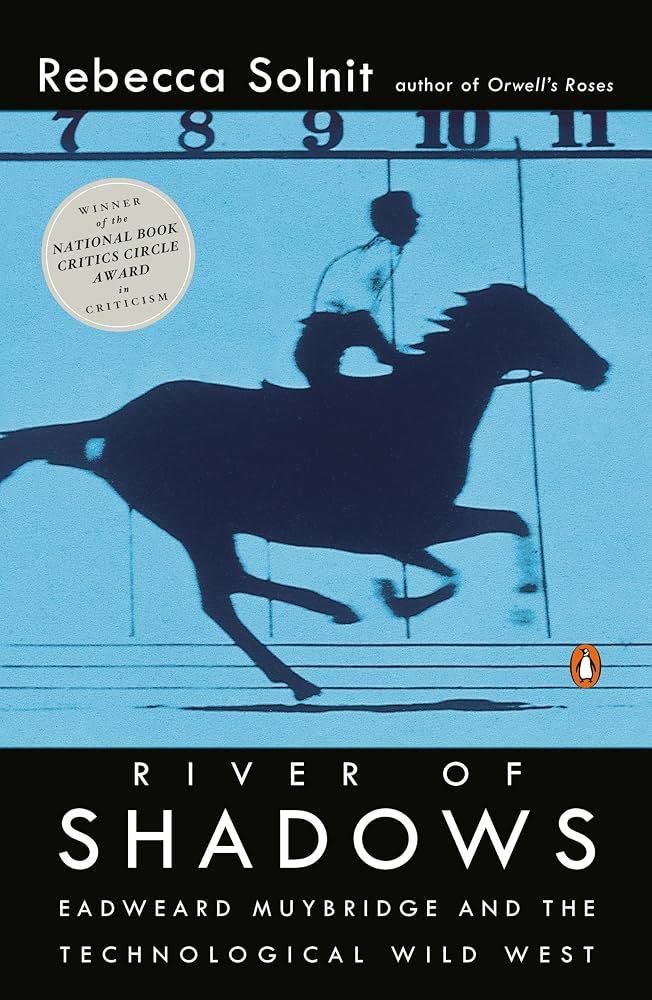
“Hollywood and Silicon Valley became, long after these men died, the two industries California is most identified with, the two that changed the world. They changed it, are changing it, from a world of places and materials to a world of representations and information, a world of vastly greater reach and less solid grounding.”
“Muybridge is the man who split the second, as dramatic and far-reaching an action as the splitting of an atom.”
Early railroads in 1830s annihilated time and space at 20-30 mph
Geology was the key science of the Victorian era, physics of modern, and genetics of today
“The railroad shrank space through the speed of its motion. Geology expanded time through the slowness of its processes and the profundity of its changes.”
“The art of the hand had been replaced by the machinery of the camera; the travel of the foot, human or equine, had been replaced by the pistons of the locomotive; bodies themselves were becoming insulated from nature by machinery and manufactured goods; and memory had been augmented and partly replaced by photography, that freezing eye whose gaze soon reached the corners of the world.”
Like Darwin’s evolution theories of same time, photography brought people out of “river of time” onto dry land without current
New industrial age, with its tightly enforced schedules and machinated production was “a runaway train of consumption driving production driving consumption”
re: Hawthorne’s “The Celestial Railroad”: “The old world, Hawthorne seemed to argue, was arduous, but it knew where it was going, and it went the slow sure way. Machines made life easier, faster, more predictable, but they led away from an integrity that people missed from the beginning.”
“Muybridge was a doorway, a pivot between that old world and ours, and to follow him is to follow the choices that got us here.”
Muybridge went to Yosemite in 1867, after it was set apart in 1864; first government to do
Golden spike of transcontinental railroad wired to send telegraph message across the country the moment it struck
Transcontinental railroad was an extensive network, and power drew people into the system, pushed back independence of the frontier, and made Americans feel like cogs in machine for the first time
“The Europeans had mostly noticed what they were gaining; the colonized who had less to gain kept their eyes on what was being lost.”
“Cinema would itself be a kind of Ghost Dance. It was and is a breach in the wall between past and the present, one that lets the dead return, albeit as images of flickering light rather than phantoms in the dark or armies marching across the land. Anyone who watches old movies watches the dead, and Edison was not yet insulated as we are against what is macabre about this.”
“The technological solution called forth by photography and later mutated into film, television, video, computer animations, succeeded so profoundly that it has become the medium in which we live, but it is only a medium of flickering light and darkness, a river of shadows.”
“They were all technologies of grief, technologies for building a bridge across the painful divide between the living and the dead, between what had been and what is, for defeating the trauma of time itself.”
Shot and killed his wife’s lover but acquitted by jury of 12 married men
Panoramas of Yosemite, then transitioned to motion studies using cameras with electrical controls at Stanford, which was built to commemorate son who had died of flu in Europe
In hindsight, the horse photos were the origin of cinema, but at the time were viewed as breakthrough for photography and motion studies
Put together exhibit at the Chicago World’s Fair in 1893; “Zoopraxigraphical Hall” was financial failure (early weeks of fair)