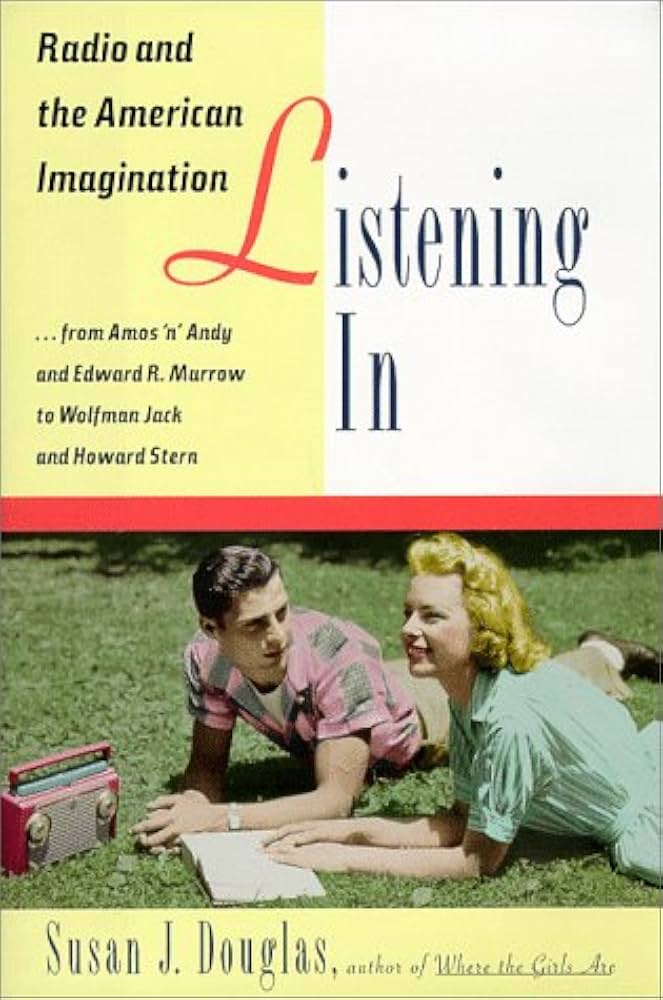
“The most pivotal development, Anderson argued, that transformed hunks of populated territories into imagined communities of nations was the newspaper. Every morning, at roughly the same time, people read of the same stories about the nation, its leaders, and some of their fellow citizens in the newspaper. It was this daily ritual of taking in the same stories, the same knowledge, at the same time as you knew those who shared your country where, that forged this sense of comradeship with unseen others.”
“We can passively hear, but we must actively listen.”
Absence of imagery forces brain to generate own dream world; immediate and transitory power
Listening is centripetal; looking is centrifugal
Auditory system feeds into limbic system, which generates associations and emotional states
Types of listening: informational, dimensional (imagining space, and music), and associational (creating memories tied to audio)
FM waves travel to horizon then off into space (50 miles); AM waves follow curve of earth, can be bounced back by ionosphere and land hundreds of miles away
Aurality linked to cosmology: religious experience; “ether” helped bridge widening gap between machines and spirituality
“Radio burrowed into this unspoken longing for a contact with the heavens, for a more perfect community, for a spiritual transcendence not at odds with, but made possible by, machines.”
Post WW1 craze of séances and ether experiments to communicate with dead
Edison: “Centuries after you have crumbled into dust, [the phonograph] will repeat again and again to a generation that will never know you, every idle thought, every find a fancy, every vain word that you choose to whisper against this thin iron diaphragm.”
Ether helped people imagine electromagnetic propagation; also made radio seem inherently magical
Mix of voices, static, dots and dashes a “new sonic dimension”
Radio first called wireless telegraphy, then wireless telephony, before settling on radio in 1920s
Required assembly and exploration to find stations; men and boys brought into home
Listening stages:
- Early 1920s: DXing: tuning into faraway stations
- Mid 1920s: music listening
- Late 1920s: story listening (Amos & Andy)
Early enthusiasts enjoyed the challenge of assembly and tinkering despite hassles
Early 1920s all stations and programming were local so DXers captured regional flavors
“DXing brought contradictory pleasures: the smugness of regional superiority blended with the pleasure of imagining a national entity, something grand, with a life of its own, of which you were part. It affirmed both hopes, that America was some kind of culturally cohesive whole but one that resembled a jigsaw puzzle of unique, definable pieces.”
“The coincidence of jazz and radio married an aural technology with the fruits of a primarily oral culture.”
re: race “With the radio as auditory turnstile between cultures, there were enormous enrichments, illusions, and delusions for both sides.”
By 1930s a standardized diction for commercials contrasted with wilder pronunciations in programs
Radio comedies (Amos & Andy) linguistic slapstick, vaudevillian, anarchic counter to Victorian sensibilities, and relief during Depression
Social sciences began during Great Depression trying to understand mythology of American dream
In 1925, 10% had radio, 1933 62%
World War II an audio war, despite modern emphasis on visual elements
Marot and other war correspondence used everyday speech and informalism
“FDR had hardly ignored the fact that in the 1936 campaign most of the country’s editorial pages had opposed his reelection. Support for him and for the new deal had been achieved very much through his administration’s adroit and calculated use of radio. But by 1940 more than one-third of the country’s radio stations were owned by newspapers. FDR regarded this as a direct threat to his policies. The FCC in 1938 began an investigation into monopoly practices — what was called chain broadcasting — in the industry. Privately, the president in 1940 asked the new FCC Chairman, Lawrence Fly, “Will you let me know when you propose to have a hearing on newspaper ownership of radio stations?” Publicly, through his press secretary, Steve Early, Roosevelt told broadcasters that “the government is watching” to see if they air any “false news.” Radio, Early warned, “might have to be taught manners if it were a bad child.” Network executives understood “false news” to be news critical of the administration’s policies.”
Masculine pastimes like baseball and boxing brought into the home, build a nationalistic feeling
Sportscasting began in 1930s in baseball and boxing
Baseball listening a “sensory intertwining of public and private life”, associative memories of summer, youth, and America’s past
Louis/Schmeling fights a proxy war between Germany and United States; though Louis was black, better him than a Nazi as a world champion
Away games weren’t broadcast so announcers recreated based on telegrams coming in
Rock and pop radio in 1950s for cool teens who like “race music”
FM Revolution, build on the success of transistors, enhanced sound into stereo and high fidelity
Author links talk radio boom of the 1980s and 90s to backlash against feminism and Vietnam syndrome weakness, and abandoning Fairness Doctrine
Major deregulations in ownership limits in 1980s lead to consolidations by conglomerations
Stern, Imus, and Limbaugh the chief figures of male radio backlash; NPR the counterpoint, but still all showcases for non-mainstream voices
Talk radio and NPR where about “using the airwaves to reinvigorate democracy” by giving “nonmonied classes” their say too
Ham radio pre-dominantly male, nerdy niche but necessary in emergencies
“Ham” originally term for sloppy telegraph operators; pejorative turned into name of pride
Democratic, meritocratic tribe; emphasis on altruism and comity
“Buried today as we are under the avalanche of visual slag, many people seem to want increased input in shaping the often top-down meanings of the media. I think we want our imaginations back. I think we want—and need—to listen.”