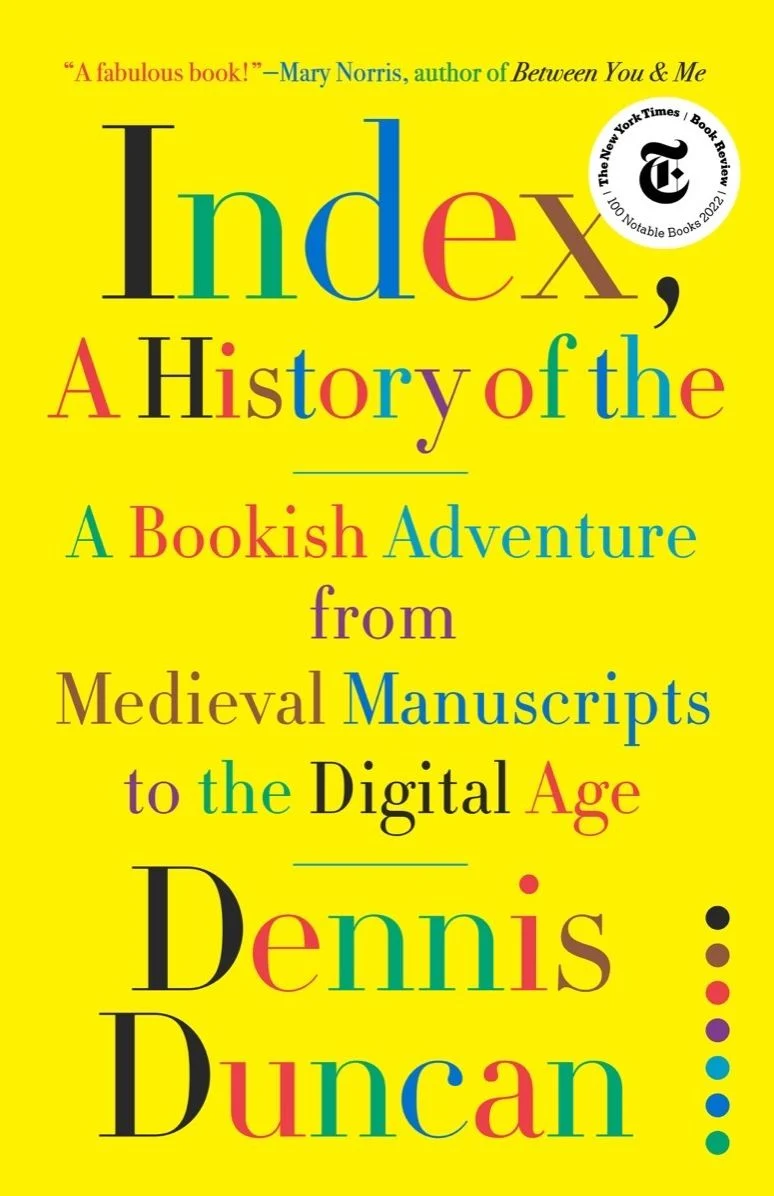
Indexer as mediator between author and audience
Like library catalog, index distills source work to create something new and separate
Table of contents follow order of work and reveal its architecture
“It is not hard to see why the index is an invention of the codex era, and not the age of the scroll. It is a truly random-access technology, and as such it relies on a form of the book that can be opened with as much ease in the middle, or at the end, as at the beginning. The codex is the medium in which the index first makes sense.”
Anglicized indexes v. Latinate indicies – Shakespeare used former
Galileo grumbled about armchair philosophers who, instead of venturing into the world, would “retire to their studies and glance through an index or a table of contents to see whether Aristotle has said anything about them”
“Reading does not have a Platonic ideal (and, for Plato, as we will find out, it was far from ideal.) What we consider to be normal practice has always been a response to a complex of historical circumstances, with every shift in the social and technological environment producing an evolutionary effect in what ‘reading’ means.”
“The ideal index anticipates how a book will be read, how it will be used, and quietly, expertly provides a map for these purposes.”
Alphabetical order considered in Middle Ages to be “antithesis of reason”, abdication of scholarly responsibility to discern God’s harmonious order of universe
In library of Alexandria, scrolls labeled with parchment tag sillybos (syllabus) to describe contents; Cicero used indices for same
Bibliophylax: Keeper of the Library
Alphabetical order at Alexandria represented “huge intellectual leap” from intrinsic characteristics to arbitrary system
Iliad and Odyssey were divided into 24 books for each Greek letter by Library grammarians
As universities started forming after 1000 AD and emphasis on outward evangelism outside of monasteries, need for “textual agility” and tools for “fast, ordered way of thinking”
English cleric Stephen Langton chaptering of the Bible by 1204 at behest of his university
Distinctio older brother to index – “bite-sized cribsheet on a given theme”, like a dictionary definition’s multiple meanings/senses of a word or theme; often used for preaching; associative “mindmap of a moment of creative reading”
Robert Grosseteste—13th century English lecturer, preacher, Chancellor of Oxford and Bishop of Lincoln—devised index to cross-reference biblical themes with other verses, church and pagan works
First Bible concordance started in 1230 Paris at St Jacques friary by prior Hugo
The monk Werner Rolevinck first to include page numbers, on 1470 sermon
Anxiety about people who only read index in place of whole book almost as soon as indexes became widespread
“The concept of learning itself is an adaptable one, evolving in response to the technology of its time; that what might once seem a diminution, the betrayal of an ideal, can come to be seen as essential, an ideal itself; that scholarship, rather than being timeless and immutable, is shifting and contingent, and that the questions that we ask as scholars have a lot to do with the tools at our disposal.”
“The professional indexer, learned, vigilant, goes before us, levelling mountains and beating paths so that we, time-poor students at the fingerpost, can arrive swiftly but unruffled at the passage—the quotation, the datum, the knowledge—we need.”
“Looking to the future, we find that the book, the old-fashioned paper-and-ink book, its pages unreflowable, bound at the spine, has proved an enduring technology in the face of its electronic offspring. For the time being, at least, it retains its place as the dominant symbol of our intellectual endeavors, displayed on our shelves and on the crests of the great universities. As long as we navigate the waters of print, the book index, child of the imagination but as old as those universities themselves, will continue to serve as our compass.”