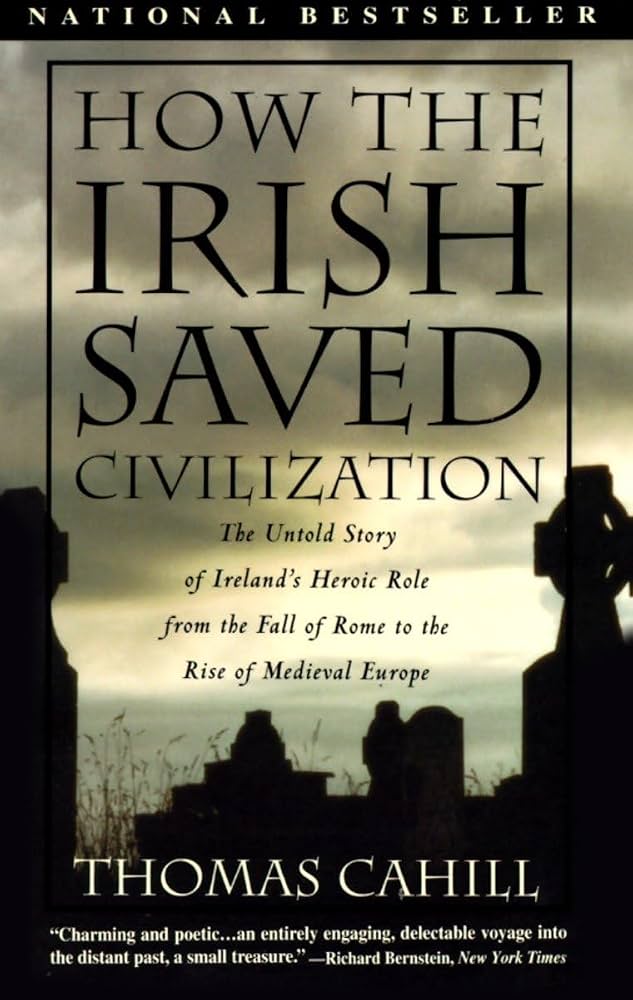
Mediterranean – “sea of middle earth”
Prophecy of the Twelve Eagles, each one representing a century, meant due to end by end of 400s
Debate about whether Rome fell due to internal weakness or external forces (barbarians)
Tax collectors (curialis) usually small landowners without hope of escaping caste; personally responsible for whatever they couldn’t collect
Roman upper class and senators exempt from taxes, so tax base shrunk as great landowners acquired others; prototype of medieval fiefdoms
Army harder to maintain, with more non-Romans and mercenaries sent instead of wealthy
Visigoths, led by Alaric, invaded northern Italy in 406 (sack of Rome in 410) – beginning of the end
In late antiquity the Catholic bishops were the remaining legal/moral authorities so saw their power grow
Augustine, inspired by Plato and Paul, formulated doctrines of original sin, grace, Trinity; writes first Catholic justification for state persecution of those in error (Inquisition)
Irish part of larger ethnic group of Celts; one branch settled in present-day France and became Gauls; Another become Iberian Celts
Third-century BC Celts invaded Greek world and settled in present-day Turkey and became Galatians
Siblings of Gaulish Celts crossed to Britain in 400 BC; nine centuries later pushed by Angles and Saxons into Cornwall (Cornish) and Wales (Welsh); King Arthur and Round Table legends sprang from there
Welsh and Breton in same linguistic group as Gaulish
Celtic tribes that reached Ireland a mix of Briton and Iberian, but Iberian became ascendant, with different language
Ireland “a land outside of time” from 400 BC to 500 AD – “illiterate, aristocratic, seminomadic, Iron Age warrior culture, its wealth based on animal husbandry and slavery”
On the early Irish: “Fixity escape these people, as in the end it escapes us al. They understood, as few have understood before or since, how fleeting life is and how pointless to try to hold on to things or people. They pursued the wondrous deed, the heroic gesture: fighting, fucking, drinking, art—poetry for intense emotion, the music that accompanied the heroic drinking with which each day ended, bewitching ornament for one’s person and possessions. All these are worth pursuit, and the first, especially, will bring the honor great souls seek.”
Patricius a British teenager enslaved by Irish pirates where he worked as a shepherd and became devoutly Christian; after returning home had a vision of a letter headed “The Voice of the Irish”
Patrick first missionary after Paul, 400 years later
Latin pagus (pagans) for uncultivated countryside of rustic and threatening bumpkins
Patrick first person in history to speak out unequivocally against slavery
Patrick: earthy, warm, caring, courageous, loyal, generous, humorous; “the Irish found Patrick admirable according to their own highest standards”
Patrick “had transmuted their pagan virtues of loyalty, courage, and generosity into the Christian equivalents of faith, hope, and charity.”
Of Patrick’s vision of the world has holy: “In this tradition, there is a trust in the objects of sensory perception, which are seen as signposts from God. But there is also a sensuous reveling in the splendors of the created world, which would have made the Roman Christians exceedingly uncomfortable.”
Ritual human sacrifice was still common; Patrick’s message (via Paul) was that Christ was the final sacrifice
Patrick’s humor and love for the world put him at farther distance from serious self-obsessed Augustine
Despite Edict of Milan that legalized Christianity in 313, Christianity never transformed Roman culture like it did Ireland
“The Irish never troubled themselves overmuch about eradicating pagan influences, which they tended to wink at and enjoy.”
“Patrick, the incomplete Roman, nevertheless understood that, though Christianity was not inextricably wedded to Roman custom, it could not survive without Roman literacy.”
Since Ireland is only land inculcated with Christianity without violence and martyrdom, Irish of 5th-6th century created Green Martyrs: “those who, leaving behind the comforts and pleasures of ordinary human society, retreated to the woods, or to a mountaintop, or to a lonely island—to one of the green no-man’s-lands outside tribal jurisdictions—there to study the scriptures and commune with God.
Green Martyrs gave way to monasteries unconcerned about orthodoxy or uniformity: “In their unrestrained catholicity, they shocked conventional churchmen, who had been trained to value Christian literature principally and give a wide berth to the dubious morality of the pagan classics.” … “It was not that the Irish were uncritical, just that they saw no value in self-imposed censorship.”
Irish scribes copying Greek, Latin, and Hebrew works: “They did not see themselves as drones. Rather, they engaged the text they were working on, tried to comprehend it after their fashion, and, if possible, add to it, even improve on it. In this dazzling new culture, a book was not an isolated document on a dusty shelf; book truly spoke to book, and writer to scribe, and scribe to reader, from one generation to the next. These books were, as we would say in today’s jargon, open, interfacing, and intertextual—glorious literary smorgasbords in which the scribe often tried to include a bit of everything, from every era, language, and style known to him.”
“Like the Jews before them, the Irish enshrined literacy as their central religious act. In a land where literacy had previously been unknown, in a world where the old literate civilizations were sinking fast beneath successive waves of barbarism, the white Gospel page, shining in all the little oratories of Ireland, acted as a pledge: the lonely darkness had been turned into light, and the lonely virtue of courage, sustained through all the centuries, had been transformed into hope.”
On the decorative aspect of literacy: “For their part, the Irish combined the stately letters of the Greek and Roman alphabets with the talismanic, spellbinding simplicity of Ogham to produce initial capitals and headings that rivet one’s eyes to the page and hold the reader in awe.”
The shape of the modern codex was determined by the dimensions of a sheepskin, taller than wide to be cut into double folded pages
Lacking cities, Ireland changed religious-political structure of Christianity from bishoprics and Roman-influenced dioceses to abbots and abbesses ruling over increasingly powerful monastic communities/city-states
Larger female presence “contributed to the teeming variety of Irish religious life—a variety that would have distressed the Romans, had they known of it.”
Confession and penance in ancient church was public and limited, but “Irish innovation was to make all confession and completely private affair between penitent and priest—and to make it as repeatable as necessary.”
As Europe’s cities and libraries fell in sixth century, “Ireland, at peace and furiously copying, thus stood in the position of becoming Europe’s publisher.”
Pagan Saxon settlements of southern England had cut Ireland off from easy commerce with Europe, so “while Rome and its ancient empire faded from memory and a new, illiterate Europe rose on its ruins, a vibrant, literary culture was blooming in secret along its Celtic fringe.”
Columcille/Columba , spiritual son of Patrick and missionary of monasteries, founded popular abbey of Iona; “warrior-monk” who had “created by his singular determination a literate, Christian society” among the Scots and Picts of northern Britain
Irish the first vernacular literature to be written down
Hebrew Bible would have been preserved by scattered Jewish communities and Greek by Byzantines, but Latin literature would have been lost
“Both the Celtic and the Saxon myths and legends were becoming, in fact, secular Old Testaments, histories that lacked the direct revelations of Abraham and Moses, but symbolic salvation histories nonetheless, where one could read of a people journeying, by trial and error, prophecy and instinct, toward the truth, propelled forward through darkness and death by their own innate goodness.”
Charlemagne’s coronation as king of France and Holy Roman Emperor in 800 led to “medieval Europe’s first Renaissance, a short-lived cultural flowering that barely outlasted his reign”; gradual revival of literacy spurred by wandering monks
Iona and other monasteries raided and sacked repeatedly by Nordic Vikings throughout 800s; books and treasures buried or sent inland
Repeated invasions throughout the next millennium: Normans in 1100s, Calvinist Cromwellians in 1600s, anti-Catholic Penal Laws in 1700s