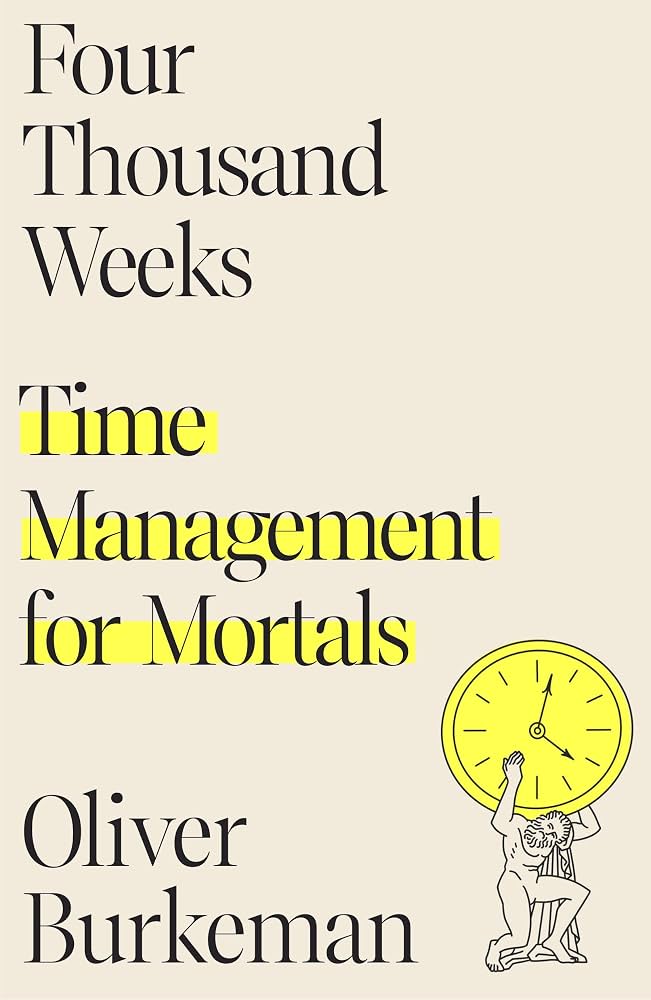
“Most of us invest a lot of energy, one way or another, in trying to avoid fully experiencing the reality in which we find ourselves. We don’t want to feel the anxiety that might arise if we were to ask ourselves whether we’re on the right path, or what ideas about ourselves it could be time to give up.”
“Our troubled relationship with time arises largely from the effort to avoid the painful constraints of reality.”
“The confrontation with limitation also reveals the truth that freedom, sometimes, is to be found not in achieving greater sovereignty over your own schedule but in allowing yourself to be constrained by the rhythms of community.”
“This notion that fulfillment might lie in embracing, rather than denying, our temporal limitations wouldn’t have surprised the philosophers of Ancient Greece and Rome. They understood limitlessness to be the sole preserve of the gods; the noblest of human goals wasn’t to become godlike, but to be wholeheartedly human instead.”
“Existential overwhelm” feeling of having too much to do is a secular modern phenomenon due to loss of afterlife and progressive view of history; the pain of “our own little lifespan”
“The world has an effectively infinite number of experiences to offer, so getting a handful of them under your belt brings you no closer to a sense of having feasted on life’s possibilities.”
Internet: “the very tool you’re using to get the most out of life makes you feel as though you’re missing out on even more of it.”
“The technologies we use to try to “get on top of everything” always fail us, in the end, because they increase the size of the “everything” of which we’re trying to get on top.”
“Once you truly understand that you’re guaranteed to miss out on almost every experience the world has to offer, the fact that there are so many you still haven’t experienced stops feeling like a problem. Instead, you get to focus on fully enjoying the tiny slice of experiences you actually do have time for—and the freer you are to choose, in each moment, what counts the most.”
“Smoothness, it turns out, is a dubious virtue, since it’s often the unsmoothed textures of life that make it livable, helping nurture the relationships that are crucial for mental and physical health, and for the resilience of our communities.”
“You have to choose a few things, sacrifice everything else, and deal with the inevitable sense of loss that results.”
“Life is usually more comfortable when you spend it avoiding the truth. But it’s a stultifying, deadly sort of comfort. It’s only by facing our finitude that we can step into a truly authentic relationship with life.”
“Bright sadness” (Richard Rohr); “stubborn gladness” (Jack Gilbert); “sober joy” (Bruce Ballard)
“If you can hold your attention, however briefly or occasionally, on the sheer astonishingness of being, and on what a small amount of that being you get—you may experience a palpable shift in how it feels to be here, right now, alive in the flow of time.”
“Maybe it’s not that you’ve been cheated out of an unlimited supply of time; maybe it’s almost incomprehensibly miraculous to have been granted any time at all.”
David Cain: “I happen to be alive, and there’s no cosmic law entitling me to that status. Being alive is just happenstance, and not one more day of it is guaranteed.”
“When you’re trying to Master Your Time, few things are more infuriating than a task or delay that’s foisted upon you against your will, with no regard for the schedule you’ve painstakingly drawn up in your overpriced notebook.”
“Making a choice—picking one item from the menu—far from representing some kind of defeat, becomes an affirmation.”
Principle #1: pay yourself first when it comes to time (do what truly matters first and schedule time for it)
Principle #2: limit your work in progress (no more than three)
Principle #3: resist the allure of middling priorities
“Since every real-world choice about how to live entails the loss of countless alternative ways of living, there’s no reason to procrastinate, or to resist making commitments, in the anxious hope that you might somehow be able to avoid those losses. Loss is a given. That ship has sailed—and what a relief.”
“We tend to think of [boredom] merely as a matter of not being particularly interested in whatever it is we’re doing, but in fact it’s an intense reaction to the deeply uncomfortable experience of confronting your limited control.”
“The way to find peaceful absorption in a difficult project isn’t to chase feelings of peace or absorption, but to acknowledge the inevitability of discomfort, and to turn more of your attention to the reality of your situation than to railing against it.” [M. Scott Peck’s “life is difficult”; “the obstacle is the way”]
“There is a very down-to-earth kind of liberation in grasping that there are certain truths about being a limited human from which you’ll never be liberated.”
His baby was “sheer presence, participating unconditionally in the moment in which he found himself”
“The capitalist pressure toward instrumentalizing your time saps meaning from life. … We choose to treat time in this self-defeatingly instrumental way, and we do so because it helps us maintain the feeling of being in omnipotent control of our lives.”
“Spending at least some of your leisure time “wastefully,” focused solely on the pleasure of the experience, is the only way not to waste it—to be truly at leisure, rather than covertly engaged in future-focused self-improvement. In order to most fully inhabit the only life you ever get, you have to refreshing from using every spare hour for personal growth.”
Three principles of patience: develop a taste for having problems, embrace radical incrementalism, originality lies on the far side of unoriginality
“Cosmic insignificance therapy is an invitation to face the truth about your irrelevance in the grand scheme of things. To embrace it, to whatever extent you can.”
Carl Jung: “Your questions are unanswerable, because you want to know how to live. One lives as one can. There is no single, definite way. … If you do with conviction the next and most necessary thing, you are always doing something meaningful and intended by fate.”