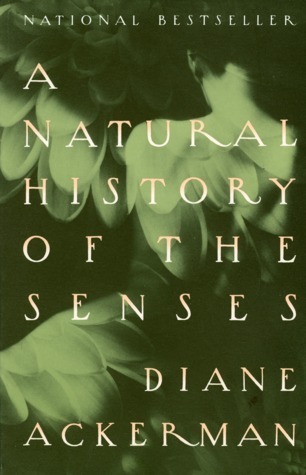
Oliver Wendell Holmes: “A mind that is stretched to a new idea never returns to its original dimension.”
“What is most amazing is not how our senses span distance or cultures, but how they span time. Our senses connect us intimately to the past, connect us in ways that most of our cherished ideas never could.”
“The senses don’t just make sense of life in bold or subtle acts of clarity, they tear reality apart into vibrant morsels and reassemble them into a meaningful pattern.”
“It is both our panic and our privilege to be mortal and sense-full. We live on the leash of our senses. Although they enlarge us, they also limit and restrain us, but how beautifully. Love is a beautiful bondage, too.”
“We like to think that we are finely evolved creatures, in suit-and-tie or pantyhose-and-chemise, who live many millennia and mental detours away from the cave, but that’s not something our bodies are convinced of. … We still create works of art to enhance our senses and add even more senses rooms to the brimming world, so that we can utterly luxuriate in the spectacles of life.”
“The brain is a good stagehand. It gets in with its work while we’re busy acting out our scenes.”
“Our sense of smell can be extraordinarily precise, yet it’s almost impossible to describe how something smells to someone who hasn’t smelled it. … Smell is the mute sense, the one without words.”
“There is a furnace in our cells, and when we breathe we pass the world through our bodies, brew it lightly, and turn it loose again, gently altered for having known us.”
“When we try to describe a smell, words fail us like the fabrications they are. Words are small shapes in the gorgeous chaos of the world.”
“The charm of language is that, though it’s human-made, it can on rare occasions capture emotions and sensations which aren’t.”
“Smells are our dearest kin, but we cannot remember their names.”
“In a world sayable and lush, where marvels offer themselves up readily for verbal dissection, smells are often right on the tip of our tongues—but no closer—and it gives them a kind of magical distance, a mystery, a power without a name, a sacredness.”
“Unlike the other sense, smell needs no interpreter. The effect is immediate and undiluted by language, thought, or translation. A smell can be overwhelmingly nostalgic because it triggers powerful images and emotions before we have time to edit them.”
“Much of life becomes background, but it is the province of art to throw buckets of light into the shadows and make life new again.”
“Stumbling on new smells is one of the delights of travel. Early in our evolution we didn’t travel for pleasure, only for food, and smell was essential.”
“Smell was the first of our senses, and it was so successful that in time the small lump of olfactory tissue atop the nerve cord grew into a brain. Our cerebral hemispheres were originally buds from the olfactory stalks. We think because we smell.”
“Mainly we value one scent over another thanks to Madison Avenue’s brashness and our gullibility. Aromatic paranoia pays well.”
“We don’t need [smell] to survive, but we crave it beyond all reason, maybe, in part, out of a nostalgia for a time when we were creatureal, a deeply connected part of Nature.”
“A campfire wouldn’t be as exciting if it were silent.”
“Music, the perfume of hearing, probably began as a religious act, to arouse groups of people.”
“Like pure emotions, music surges and sighs, rampages or grows quiet, and, in that sense, it behaves so much like our emotions that it seems often to symbolize them, to mirror them, to communicate them to others, and thus frees us from the elaborate nuisance and inaccuracy of words.”
“We think of our eyes as wise seers, but all the eye does is gather light.”
“Don’t think of night as the absence of day; think of it as a kind of freedom. Turned away from our sun, we see the dawning of far-flung galaxies. We are no longer sun-blind to the star-coated universe we inhabit.”
“What a strange lot writers are, we questers after the perfect word, the glorious phrase that will somehow make the exquisite avalanche of consciousness sayable.”
“There’s a sonneteer in our chests; we walk around to the beat of iambs.”
“The body’s quest isn’t for truth, it’s for survival.”
“Living on the senses requires an easily triggered sense of marvel, a little extra energy, and most people are lazy about life. Life is something that happens to them while they wait for death.”
“The brain is blind, deaf, dumb, unfeeling. The body is a transducer, a device that converts energy of one sort to energy of another sort, and that is its genius.”
“[Our senses] bridge the personal and the impersonal, the one private soul with its many relatives, the individual with the universe, all of life on Earth.”
“Where there is no risk, the emotional terrain is flat and unyielding, and, despite all its dimensions, valleys, pinnacles, and detours, life will seem to have none of its magnificent geography.”
“However many of life’s large, captivating principles and small, captivating details we may explore, unpuzzle, and learn by heart, there will still be vast unknown realms to lure us.”